Sunday, May 10, 2009

Status of cancer detection

The Canary Foundation’s annual symposium held May 4-6, 2009 indicated progress in two dimensions of a systemic approach to cancer detection: blood biomarker identification and molecular imaging analysis.

Systems approach to cancer detection
A systems approach is required for effective cancer detection as assays show that many proteins, miRNAs, gene variants and other biomarkers found in cancer are also present in healthy organisms. The two current methods are one, looking comprehensively at the full suite of genes and proteins, checking for over-expression, under-expression, mutation, quantity, proximity and other factors in a tapestry of biological interactions and two, seeking to identify biomarkers that are truly unique to cancer, for example resulting from post-translational modifications like glycosylation and phosphorylation. Establishing mathematical simulation models has also been an important step in identifying baseline normal variation, treatment windows and cost trade-offs.

Blood biomarker analysis
There are several innovative approaches to blood biomarker analysis including blood-based protein-assays (identifying and quantifying novel proteins related to cancer), methylation analysis (looking at abnormal methylation as a cancer biomarker) and miRNA biomarker studies (distinguishing miRNAs which originated from tumors). Creating antibodies and assays for better discovery is also advancing particularly protein detection approaches using zero, one and two antibodies.

Molecular Imaging
The techniques for imaging have been improving to molecular level resolution. It is becoming possible to dial-in to any set of 3D coordinates in the body with high-frequency, increase the temperature and destroy only that area of tissue. Three molecular imaging technologies appear especially promising: targeted microbubble ultrasound imaging (where targeted proteins attach to cancer cells and microbubbles are attached to the proteins which make the cancerous cells visible via ultrasound; a 10-20x cheaper technology than the CT scan alternative), Raman spectroscopy (adding light-based imaging to endoscopes) and a new imaging strategy using photoacoustics (light in/sound out).

Tools: Cancer Genome Atlas and nextgen sequencing
As with other high-growth science and technology areas, tools and research findings evolve in lockstep. The next generation of tools for cancer detection includes a vast cataloging of baseline and abnormal data and a more detailed level of assaying and sequencing. In the U.S., the NIH’s Cancer Genome Atlas is completing a pilot phase and being expanded to include 50 tumor types (vs. the pilot phase’s three types: glioblastoma, ovarian and lung) and abnormalities in 25,000 tumors. The project performs a whole genomic scan of cancer tumors, analyzing mutations, methylation, coordination, pathways, copy number, miRNAs and expression. A key tool is sequencing technology itself which is starting to broaden out from basic genomic scanning to targeted sequencing, whole RNA sequencing, methylome sequencing, histone modification sequencing, DNA methylation by arrays and RNA analysis by arrays. The next level would be including another layer of detail, areas such as acetylation and phosphorylation.

Future paradigm shifts: prevention, omnisequencing, nanoscience and synthetic biology
Only small percentages of annual cancer research budgets are spent on detection vs. treatment, but it is possible that the focus will be further upstreamed to prevention and health maintenance as more is understood about the disease mechanisms of cancer. Life sciences technology is not just moving at Moore’s Law paces but there are probably also some paradigm shifts coming.

The three most suggestive areas for coming life science discontinuities are genomic sequencing, nanoscience and synthetic biology.
Genomic sequencing contemplates the routine scanning of each individual and tumor at multiple levels: genomic, proteomic, methylomic, etc. Nanoscience is the ability to design, construct and render mobile a large variety of molecular [biological] devices. Synthetic biology is designing new or modifying existing biological pathways in order to produce systems with superior or different properties, exercised by both traditional practitioners (recent conferences: Advances in Synthetic Biology, Synthetic Biology 4.0) and diybio’ers.

Sunday, May 03, 2009

Opportunities in level-two nanoscience

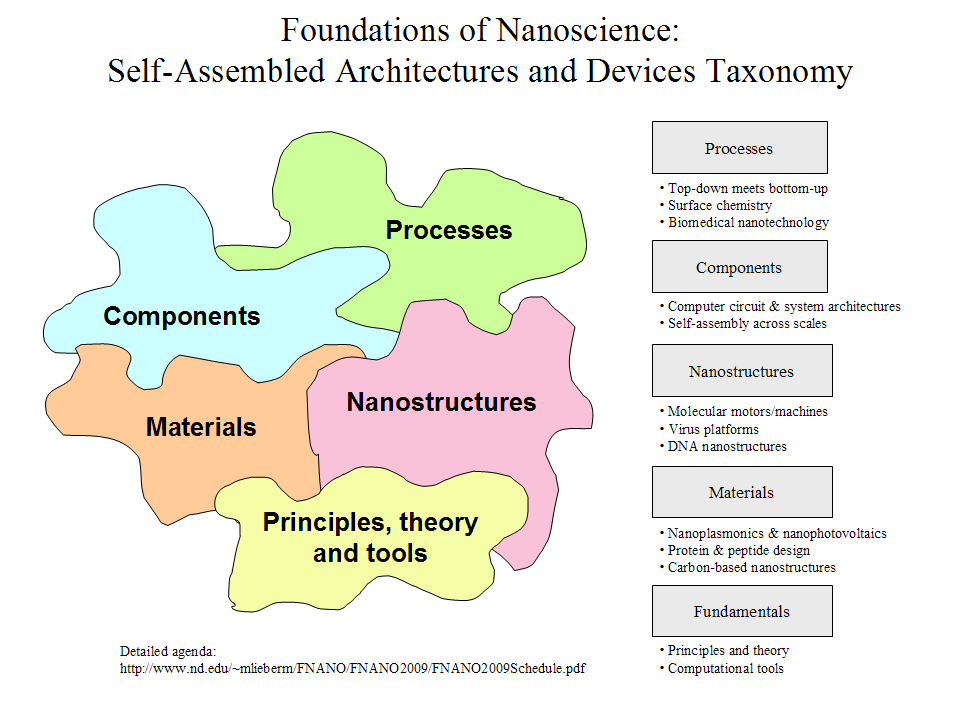
The April 20-24, 2009 Foundations of Nanoscience conference at Snowbird UT provided an interesting look at the wide variety of subfields and applications for nanoscience in thirteen tracks roughly organized into five areas: principles, materials, nanostructures, components and processes (Taxonomy, Quick Reference Guide to Current Research). Many of the nanoscience subfields have been in existence for five to ten years, however the different nanotechnology science and commerical efforts are still fairly isolated (for example, there could be an NNI roadmapping initiative). Nanoscience is largely still at the stage of experimental demos rather than quick advances to commercialization. The diversity of approaches demonstrates creativity and the increasing complexity, refinement and sophistication signals that nanoscience could be moving into a more mature era.

Definition and applications
Nanoscience is the interdisciplinary nexus of several fields including chemistry, physics, electronics, biology and materials - a convergence hub between life and technology, organics and inorganics, biotic and abiotic, top-down engineering and bottom-up nature. Researchers exhibit substrate agnosticism as approaches, techniques, tools and applications may be organic, inorganic or synthetic; the focus is on properties, functionality and requirements.

Nanoscience also encompasses fundamental understandings such as the definition of life, for example, it can be argued that self-replicating crystals constitute organic life. The potential uses of nanoscience are manifold, particularly in electronics, medicine, sensors and materials.

Drug delivery and bridging the gap from end-of-the-roadmap Moore’s Law computing to molecular electronics are the most urgent potential applications.
Figure 1: The End of Moore's Law and the gap between microprocessing and nanoprocessing

The central issue is working with today’s top-down engineered approaches which are specific but limited, to reach the molecular scale, by either extending existing methods or integrating or substituting them with molecular (organic) methods. Biology is a molecular system that works, in fact many interlinked systems. While it is messy to characterize and direct, it has tremendous potential both in its existing mechanisms and novel constructions. However, new materials and processes could be challenging to bring into the existing electronics fabrication value chain.

Status: increasing complexity and working with trade-offs
Broadly, nanoscience is currently in the phase of building on basic configurations to achieve more complex design motifs, for example scaling up circuit arrays from single to double digits, generating 3D construction materials such as 3D nanocrystals, making molecular motors from biological parts, producing active vs. static building blocks and a variety of structurally strong shapes such as icosahedra and other polyhedra. In addition to increasing complexity, another major theme is the sophisticated design trade-offs amongst a variety of parameters such as chirality, charge, planarity, time scale dynamics, thermodynamics, binding, distance, solubility, aggregation, functionalization and materials.

Wonder tools: DNA and CNTs
DNA and CNTs are the most widely used materials in nanoscience. DNA is a tremendously versatile tool not just as an information carrier and material for building structures but also as an external tagging agent on particles and as a template for directing the growth of nanocrystals and metal wires. As has long been realized, carbon nanotubes have many desirable properties for a wide range of applications but still prove elusive to manufacture to spec in large quantities.

Conclusion: moving nanoscience to nanotechnology
Many fields of science now operate at the nano or molecular scale and it is clearly useful to have a foundational characterization and established toolkit for molecular science. One next phase would be moving nanoscience to nanotechnology, seeing a tight linkage between the emerging novel materials, nanostructures and architectures to the engineering and realization of applications.

Sunday, April 26, 2009

Ultimate possibilities for life and technology

Thinking really long term, what would it be like if all matter, including life, could be designed and built to specification with nanotechnology and synthetic biology? Form factor could become ephemeral and purpose-driven. An intelligence could embody as a human, as a fleet of starships, as a crane, as a school of nanoparticles, or remain digital.

Some interesting issues could come up, say from having multiple persistent copies of one intelligence. What would the social, legal, economic etiquette and governing laws be? Or would these words even make sense anymore? The notion of the distinct individual may become obsolete.

Transhumanism will be an interesting and certainly divisive step, when groups or all humans have radically enhanced capabilities as compared with today. Posthumanism, the moment of speciation, may be quite a shock.

What about utility functions? In a digital format, traditional biological functions make a lot less sense. And what about emotion? Is there a relevant adaptation for the digital substrate or is emotion just another biology-based information system?

What is intelligence and is it reflected differently in a digital medium without the sensory input context of the physical world? Maybe intelligence is nothing more than manipulating patterns of information.

Finally, what are the ultimate possibilities for life and technology once joined? What if any would the activity be? Would the focus be on aesthetics? Analytics?

Sunday, April 19, 2009

Roadmap for Synthetic Biology

The most pressing issue in Synthetic Biology is building the groundwork to eventually advance to large-scale commercialization. How can the field’s growth from fringe to core be accelerated? A strategic plan for the Synthetic Biology ecosystem addressing academic, commercial, geopolitical and policy issues would help.

Academically, how many new bioengineering departments per year could be added? Open source course materials are available. Undergraduate and graduate bioengineering program templates including financing guidance, an industry association, faculty databases and implementation mechanisms are needed. Current academic conferences and journals could be expanded to reflect industry growth. There could be regional hands-on workshops for different levels of trained professionals and interested high-school students, similar to Math Jamborees.

Regarding enabling tools, there is a need for research and development, access ease, standardization and scale-up. Existing tools such as the PartsRegistry, OpenWetWare and Gingko Bioworks need to be taken to the next level. Academic and corporate research programs and incubators could develop a strategic roadmap for tools. An IEEE committee could be devoted to Synthetic Biology.

Commercially, there could be specific programs to involve the financing community. Venture Capital-backed SynBio Incubators could be initiated with conferences, programs, technology transfer and onsite startup incubation. Non-academic conferences, marketing and outreach programs, contests, prizes and X Prize grand challenge competitions could reside at incubators.

Safety protocols for practitioners and public discourse is a critical area for the success of Synthetic Biology. Asilomar and the Geneva Conventions could be helpful analogs for policy development.

Sunday, April 12, 2009

Gene Encyclopedia of all Life

A tremendous resource would be an open gene database of all of the genes present in eukaryotic, archaeal and bacterial life. There are several open genomic databases now but the information is organized around genomes and organisms rather than specific genes and gene function.

A gene database of all life is in the same vein as E.O. Wilson’s Encyclopedia of Life, but at the next level of detail. The Encyclopedia of Life hopes to provide a webpage with scientific information for every known species on Earth. The gene database would provide a webpage and scientific details for each gene present in life and include other information such as a cross reference to all of the different species in which the gene is expressed.

Merge the Entrez Genome Project and the PartsRegistry
The foundations and perhaps the vision and obviousness of a gene database of all life exist but not its targeted pursuit as a funded research priority. Existing genomics databases such as the U.S. NCBI’s Entrez Genome Project database could be extended and merged into one database that is more explicitly searchable by gene function, possibly joining forces with the PartsRegistry from synthetic biology which provides a homepage, datasheet and genomic sequence by gene or biological function.

NCBI’s Entrez Genome Project database genomic catalog of all life


Unifying the work of E.O. Wilson, Craig Venter, Penny Boston and Drew Endy
An interesting project would be the unification of the Encyclopedia of Life, genomics-by-organism databases and parts registry-by-gene databases together with the aggressive pursuit of cataloguing and sequencing newly discovered organisms and genes. A gene encyclopedia could rapidly extend human knowledge and facilitate the era of personalized medicine as these novel genes could have extensive application in human therapies and pharmaceuticals, energy, climate management, agriculture and other areas.
Tremendous novelty and diversity remains unstudied with species (E.O. Wilson), with organisms in the sea (Craig Venter), and with extremophile life in caves (Penny Boston); 70-90% novel organisms, most of which have not had any gene identification and sequencing, functional assessment and cataloging.

A data resource like a gene encyclopedia could also uplevel the research focus to analytics. It will be interesting to see if an era of fully fungible genes across life arises, how easy it is to transplant function and how function expresses differently in different life forms.

Sunday, April 05, 2009

Societal Design 101

Social construction and economic design like that in Dubai/the UAE is particularly interesting in two ways: what it suggests for the future of technology on Earth and in the context of designing space-based societies such as on the Moon, Mars, asteroids and orbiting satellites.

Newtech adoption as geopolitical strategy

On Earth, as technological advances are accelerating and emerging in more areas, early adopter societies, particularly less democratic ones, could mandate technology implementation and move ahead quickly. Imagine that Singapore for example, has a big push into molecular nanotechnology and develops diamond mechanosynthesis or requires adoption of life extension technologies, generating a citizenry suddenly much healthier and more productive with longer life spans, perhaps increasing GDP by one or more orders of magnitude. There will likely be a variety of worldwide responses and uptake patterns to futuretech as it emerges, possibly creating a far greater range of human diversity than currently exists. Genetically-modified food, human genomic testing and stem cell research are contemporary examples of diverse national responses to newtech.

Space-based societal design
Constructed rather than organically grown Earth-based societies are a good template for a potential Moon base and other space-based communities; societies like the Antarctic science outposts and managed economies such as Dubai and the UAE. There could certainly be any variety of non-Earth-based societies with differing levels of political and social restrictions and freedoms. Especially in the early days, stricter regimes are more likely to prevail for survival, safety and cohesion reasons.

Monday, March 30, 2009

Dubai: possibilities or probabilities?

There is an exciting energy that emanates from Dubai and the UAE, an aura of possibility and momentum that is refreshing and reduced but not fully hijabed by the global economic crisis and local market bubble burst (gulf area GDP growth of 1% expected in 2009 vs. average worldwide contraction). Things can happen very quickly in the UAE because it is a managed economy with greenfield opportunities;

socially, economically and politically, everything is architected;
if the right person can be reached, decisions can be made quickly, world-class talent can be recruited and economic incentives, funding and operational support can be provided. However, just because things can happen quickly does not mean they do or will.

Strategic plan for the UAE
What would have to happen to make Dubai and the UAE have a higher probability of being a long-term world-leading society, to shift into being an ideas and innovation-driven economy?

First, there would need to be a wide-spread awareness and interest in really being a leading society of the future, moving beyond energy, cargo, financial services, construction and tourism.

Second would be building a culture of ideas and innovation, having world-class scientists based onsite in a large scale conducting research and development. This could be executed by either building research labs or more fundamentally, by establishing one or more externally-recognized world-class accredited universities with scientists and technologists focusing the majority of their time on research.

Third would be creating a broad culture for entrepreneurship including standard financing entry, expansion and exit mechanisms, liberalization of visas, business licensing and facilities requirements (e.g.; legality of home-based software programming businesses; visas automatically issued to those with computer science degrees) and the establishment or improvement of bankruptcy laws.

Example: Masdar City

Status as of March 24, 2009 and in Designer Mockup

Masdar, city of the future, is an interesting experiment that if executed correctly could be a pilot project for a larger effort, expanding from energy and materials to infotech and biotech. Masdar could benefit from a research focus at the MIST university and a tight linkage between university tech transfer, tech incubation and entrepreneurial efforts in Masdar City.

Sunday, March 22, 2009

Integration of life and technology

Life and technology are thought of as discrete but they are starting to converge (a detailed explanation is here) and could continue to become increasingly integrated, unified as is sought with the physical laws. Life sciences have evolved from being an art to a science to now an engineering problem. Life is complex but finite and it is quite possible that all biological processes, human and otherwise, will be understood and managed, including disease and death. All matter, including life, could be designed to spec in the future; the aims of synthetic biology, building genetically-precise organisms from the bottom up, programmable matter and molecular nanotechnology are early examples. In the future, form factor and embodiment could be temporary and determined by purpose.


The above graphic represents the evolution of human and machine intelligence. Given the faster pace of technology advancement, a crossover point, sometimes called the technological singularity is inevitable. Futurist Ray Kurzweil expects this point of machine intelligence surpassing [current] human intelligence in 2029. The two curves could merge (the Human’ line above), with humans reengineering themselves into technology that can learn and evolve as fast as information technology. In actuality, there may be many forms of biological life integrating with technology and more ‘human’ diversity than has ever existed.

Future of intelligence
It is not clear that there is anything special or inherently undesignable or unreplicable about intelligence. Intelligence may be nothing more than the manipulation of patterns of information, and presumably could be substrate agnostic and executor agnostic.

Sunday, March 15, 2009

Future of physics

The future of physics and cosmology was discussed at length at a recent conference held by the foundational physics research institute FQXi, particularly considering what may be ultimately possible and impossible for physics.

Theoretical physics has been progressing in many areas but there is still a strong need for observational evidence and/or alternative theories to support or disprove the existing ones. Luckily, much anticipated experimental evidence may be available in the next few years from the Large Hadron Collider (LHC), Planck Satellite, Pierre Auger Observatory and other observational astrophysics projects. For example, the Planck Satellite aims to look farther back in time than has been seen so far with the Cosmic Background Explorer (COBE), earlier than the 400,000 year old universe. It is theorized that B-modes, primordial gravitational waves from inflation, may be visible in the very early universe, which would provide additional proof of the inflationary phase occurring directly after the big bang.

Composition of dark energy to be known soon?
Another specific example for which observational evidence may be obtained in the next few years is regarding the composition of dark energy, whether it is vacuum energy made up of axion particles as one multiverse theory predicts or quintessence made up of supersymmetric WIMPs.

Many outstanding physics questions
Some other key issues are how our universe was created in the first place (a quantum theory of creation), proof for multiverse theories and possibly detecting bubble universe collisions, more about post-big bang inflation, why there is so much more antimatter than matter (the antimatter problem), why the weak force is 1032 times stronger than gravity (vs. say a more acceptable 3-4 orders of magnitude; the hierarchy problem), the existence, size and parameters of any additional dimensions of space, not to mention the usual unification of general relativity and quantum mechanics in a quantum theory of gravity, and finally the vexing Boltzmann brain problem, that consciousness could potentially arise from nothing but quantum fluctuations.

Next-gen astrophysics tools critical
Much progress has been made with accelerators, space-based telescopes, terrestrial array telescopes, and adaptive optics but the next era of astrophysics tools could be even more revolutionary. Accelerators are an expensive $5 billion or more and take years if not decades for fundraising, permitting, building and rendering operational. One alternative could be different kinds of accelerators which are smaller, quicker and cheaper to build, notably plasma wakefield accelerators, laser accelerators, and benchtop accelerators. Another way for tools to evolve could be with computational astrophysics and simulations such as MICA's Newtonian N-body simulation (featured by UgoTrade). As computing power continues to grow, accelerator and telescope datasets could be the inputs to large-scale simulation, prediction and test. As nearly every other science has moved into informatics and rigorous math-based prediction, simulation and experimentation, so too could astrophysics, fostering much quicker cycles and a tighter linkage between theoretical and experimental physics.

The FQXi community
Curiosity-driven physics researchers, especially those investigating risky areas on the boundaries of institutional acceptance are encouraged to apply for FQXi grants, and those understanding the value of fundamental physics research funding are encouraged to participate as donors and in the FQXi website community.

NOTE: The author is an advisor to FQXi.

Sunday, March 01, 2009

Foundations of bio-info tech convergence

The most important thing that became clear at last week’s 2nd annual Unither Nanomedical & Telemedical Technology Conference is that many different foundational technologies are starting to be in place for bio-info tech convergence. Ray Kurzweil and others herald the eventual re-engineering of humans into technology that can learn and evolve as fast as infotech but may not realize pathways for bio-info tech convergence are already underway.

Boundaries and definitions of organic and inorganic, natural and synthesized, biological and electronic are blurring into a variety of permutations.

It is almost becoming anachronistic to talk about bio-info convergence when the focus in some fields has already progressed to resolving the problems at hand with the available tools which may include any variety of organic, inorganic and hybrid models.

Three key areas with developments underway:

1. Nanoparticle drug delivery systems
With 5 million people receiving some sort of cancer radiation therapy worldwide each year, and cancer quickly becoming a major killer in developing as well as industrialized countries, improvements in diagnosis and treatment are sought. The nextgen standard could be nanoparticle drug delivery systems (diagnosis is still too challenging of a problem in comparison), which could be used independently or in combination with existing radiation technologies to ameliorate treatment. Many different types of nanoparticles (carbon nanotubes, calcium phosphate, gold and various magnetic nanoparticles) and related technologies such as minimally invasive nanoXrays are under development.

2. Implanted monitors and body area networking
The most obvious case of human-device integration is pacemakers (500,000 are implanted worldwide annually). The latest versions feature one-way broadcast with the devices communicating information externally to physicians for remote monitoring; wireless heart sensors currently have an installed base in the U.S. of over 150,000. Human wireless sensing is further conceptualized as body area networking, which mainly means sensors that are internal or external to the body transmitting data one-way. The IEEE working standard for this communication is 802.15.6. The next steps would be enabling two-way broadcast, bringing some light processing on-board the implanted or external body sensors and later, augmentation. Brain-computer interfaces (BCIs) are developing in lockstep.

3. Powering implants: one idea is the ATP chip
One of the biggest challenges with devices implanted in the body is energy; providing adequate ongoing power to the device. Power trumps the other two concerns: bandwidth and biocompatibility. Many interesting methods of power generation are being investigated including thermal and vibrational energy, RF, light/PV, biochemical energy and the ATP chip, possibly getting nanodevices to produce ATP from naturally circulating glucose.

Apparently no one is yet considering the human bacterial biome as a therapeutic or augmentation platform but this could be another interesting means of bio-info tech convergence.