Showing posts with label DNA nanotechnology. Show all posts

Sunday, April 20, 2014

Fundamental Advances in DNA Nanotechnology: Probes, Synthesis, Photonics, and 3D Printing

The focus of the 11th annual conference on the Foundations of Nanoscience (FNANO) held April 14-17, 2014 in Snowbird UT was self-assembled architectures and devices. The conference continues to be important in providing a comprehensive look at fundamental enabling technologies across a range of nanoscience fields and the eventual advent of molecular electronics.

The majority of the conference discussed self-assembled architectures and devices in the context of DNA nanotechnology (using DNA as a structural building block in nanomaterials construction). DNA is the material of choice for constructing nanoscale objects. It is a useful construction material because the interactions between complementary base pairs are understood, and can be designed and built to create frames and scaffolds that hold other molecules and create structures on their own.

The main technique in DNA nanotechnology is inducing self-assembly, where advances in different methods were discussed such as lithography, 3D printing, electro-chemicals, electronics, and photonics (controlled light interactions with matter).

The scale and required replicability of nanomaterials engenders a strong focus on tool development to determine and assess the progress and quality of self-assembly and other operations. New research was presented in tools related to working with DNA such as probes, detectors, samplers, nanopores, and nanochannels (i.e. waldoes). In silico modeling and prediction remains a crucial step, for example improving the prediction of DNA and RNA folding helps in targeting RNA interference.

Synthetic biology, biomedicine, energy, and basic materials continue to be the important application areas for DNA nanotechnology.

Monday, September 09, 2013

Future of Life Sciences: Top 10 List

The next wave of the biotechnology revolution is underway and promises to reshape the world in ways even more transformative than the agricultural, industrial, and information revolutions that preceded it.

It is not unimaginable that at some point, all biological processes, human and otherwise, could be understood and managed directly.

Here is a top ten list of key areas of contemporary advance in life sciences:
  1. Synthetic Biology and Biotechnology 
  2. Regenerative Medicine and 3D Printing 
  3. Genomics, “Omics,” and Preventive Medicine 
  4. Neuroscience 
  5. Nanotechnology 
  6. Big Health Data and Information Visualization 
  7. Quantified Self (QS), Wearable Computing, and the Internet-of-Things (IOT) 
  8. DIYscience, Citizen Science, Participatory Health, and Collective Intelligence 
  9. Aging, Rejuvenation, Health Extension, and Robotics 
  10. Space 
More information: Slideshare talk from the Max Planck Institute

Sunday, August 02, 2009

Bio-design automation and synbio tools

The ability to write DNA could have an even greater impact than the ability to read it. Synthetic biologists are developing standardized methodologies and tools to engineer biology into new and improved forms, and presented their progress at the first-of-its-kind Bio-Design Automation workshop (agenda, proceedings) in San Francisco, CA on July 27, 2009, co-located with the computing industry’s annual Design Automation Conference. As with many areas of technological advancement, the requisite focus is on tools, tools, tools! (A PDF of this article is available here.)


Experimental evidence has helped to solidify the mindset that biology is an engineering substrate like any other and the work is now centered on creating standardized tools that are useful and reliable in an experimental setting. The metaphor is very much that of computing: just as most contemporary software developers work at high levels of abstraction and need not concern themselves with the 1s and 0s of machine language, in the future, synthetic biology programmers would not need to work directly with the Ac, Cs, Gs and Ts of DNA or understand the architecture of promoters, terminators, open reading frames and such. However, with synthetic biology being in its early stages, the groundwork to define and assemble these abstraction layers is currently at task.

Status of DNA synthesis
At present, the DNA synthesis process is relatively unautomated, unstandardized and expensive ($0.50-$1.00 per base pair (bp)); it would cost $1.5-3 billion to synthesize a full human genome. Synthesized DNA, which can be ordered from numerous contract labs such as DNA 2.0 in Menlo Park, CA and Tech Dragon in Hong Kong, has been following Moore’s Law (actually faster than Moore’s Law Carlson Curves doubling at 2x/yr vs. 1.5x/yr), but is still slow compared to what is needed. Right now short oligos, oligonucleotide sequences up to 200 bp, can be reliably synthesized but a low-cost repeatable basis for genes and genomes extending into the millions of bp is needed. Further, design capability lags synthesis capability, being about 400-800-fold less capable and allowing only 10,000-20,000 bp systems to be fully forward-engineered at present.

So far, practitioners have organized the design and construction of DNA into four hierarchical tiers: DNA, parts, devices and systems. The status is that the first two tiers, DNA and parts (simple modules such as toggle switches and oscillators), are starting to be consistently identified, characterized and produced. This is allowing more of an upstream focus on the next two tiers, complex devices and systems, and the methodologies that are needed to assemble components together into large-scale structures, for example those containing 10 million bp of DNA.

Standardizing the manipulation of biology
A variety of applied research techniques for standardizing, simulating, predicting, modulating and controlling biology with computational chemistry, quantitative modeling, languages and software tools are under development and were presented at the workshop.

Models and algorithms
In the models and algorithms session, there were some examples of the use of biochemical reactions for computation and optimization, performing arithmetic computation essentially the same way a digital computer would. Basic mathematical models such as the CME (Chemical Master Equation) and SSA (Stochastic Simulation Algorithm) were applied and extended to model, predict and optimize pathways and describe and design networks of reactions.

Experimental biology
The experimental biology session considered some potential applications of synthetic biology, first the automated design of synthetic ribosome binding sites to make protein production faster or slower (finding that the translation rate can be predicted if the Gibbs free energy (delta G) can be predicted). Second, an in-cell disease protection mechanism was presented where synthetic genetic controllers were used to prevent the lysis normally occurring in the lysis-lysogeny switch turned on in the disease process (lysogeny is the no-harm state and lysis is the death state).

Tools and parts
In the tools and parts session, several software-based frameworks and design tools were presented, many of which are listed in the software tools section below.

Languages and standardization
The languages and standardization session had discussions of language standardization projects such as the BioStream language, PoBol (Provisional BioBrick Language) and the BioBrick Open Language (BOL).

Software tools: a SynBio CrunchUp
Several rigorous computer-aided design and validation software tools and platforms are emerging for applied synthetic biology, many of which are freely available and open-source.

  • Clotho: An interoperable design framework supporting symbol, data model and data structure standardization; a toolset designed in a platform-based paradigm to consolidate existing synthetic biology tools into one working, integrated toolbox
  • SynBioSS - Synthetic Biology Software Suite: A computer-aided synthetic biology tool for the design of synthetic gene regulatory networks; computational synthetic biology
  • RBS Calculator: A biological engineering tool that predicts the translation initiation rate of a protein in bacteria; it may be used in Reverse Engineering or Forward Engineering modes
  • SeEd - Sequence Editor (work in progress): A tool for designing coding sequence alterations, a system conceptually built around constraints instead of sequences
  • Cellucidate: A web-based workspace for investigating the causal and dynamic properties of biological systems; a framework for modeling modular DNA parts for the predictable design of synthetic systems
  • iBioSim: A design automation software for analyzing biochemical reaction network models including genetic circuits, models representing metabolic networks, cell-signaling pathways, and other biological and chemical systems
  • GenoCAD: An experimental tool for building and verifying complex genetic constructs derived from a library of standard genetic parts
  • TinkerCell: A computer-aided design software for synthetic biology

Future of BioCAD
One of the most encouraging aspects in the current evolution of synthetic biology is the integrations the field is forging with other disciplines, particularly electronics design and manufacture, DNA nanotechnology and bioinformatics.

Scientists are meticulously applying engineering principles to synthetic biology and realize that novel innovations are also required since there are issues specific to engineering biological systems. Some of these technical issues include device characterization, impedance, matching, rules of composition, noise, cellular context, environmental conditions, rational design vs. directed evolution, persistence, mutations, crosstalk, cell death, chemical diffusion, motility and incomplete biological models.

As it happened in computing, and is happening now in biology, the broader benefit of humanity having the ability to develop and standardize abstraction layers in any field can be envisioned.
Clearly there will be ongoing efforts to more granularly manipulate and create all manner of biology and matter. Some of the subsequent areas where standards and abstraction hierarchies could be useful, though not immediate, are the next generations of computing and communications, molecular nanotechnology (atomically precise matter construction from the bottom up), climate, weather and atmosphere management, planet terraforming and space colony construction.

(Image credits: www.3dscience.com, www.biodesignautomation.org)

Sunday, May 31, 2009

The future of computing – rotaxanes?

One of the great human endeavors at the moment is being able to work at the molecular scale (e.g.; 1-100 nm), using organic and inorganic materials for a variety of purposes ranging from basic materials to computing to electronics to life sciences therapeutics to energy. This includes the designed direction of existing molecular processes (e.g.; biology) and the synthesis of novel materials, structures and dynamic behavior.

Three of the most interesting advances in working at the molecular scale and examples of bio-infotech convergence are described below…

1) Hybrid organic-inorganic rotaxanes
First is the March 2009 work of David Leigh’s lab at the University of Edinburgh in creating hybrid organic-inorganic rotaxanes. A rotaxane (rota/wheel + axis) is a mechanically-interlocked molecular structure, essentially a dumbbell shape with a ring around its middle (Figure 1), often man-made but occasionally existing in nature. In this case, the dumbbell portion of the hybrid organic-inorganic rotaxane is an organic amine, the ring around the middle is a metal.

Figure 1: Rotaxane graphical schematic and crystal structure (source)

The benefit of metal-organic frameworks is that they have the properties of both organic and inorganic materials; structural and functional properties from organic materials and electronic, magnetic and catalytic properties from inorganic materials. This rotaxane molecule has directed shuttle-like behavior, where the metal ring around the center can be pushed to bind at either end, with its biggest potential application being in quantum computing.

2) Bio-inorganic interfaces
A second interesting example of molecular scale work and bio-infotech convergence is biocomposites/GEPIs (genetically-engineered peptides for inorganics) which regulate cell behavior and improve binding at bio-inorganic interfaces by modifying surface chemistry and immobilizing infection-causing bioactive molecules. Candan Tamerler’s lab at the University of Washington is doing some interesting work in this area. Improved bio-inorganic interfaces are needed for reduced infection and seamless interaction between human wetware and implants: heart, hip, prosthetics, eye, brain, etc.

3) DNA nanotechnology
The third interesting bio-infotech convergence example is DNA nanotechnology, the notion of using DNA as a structural building material (for example, for self-directed rapid templating) rather than as an information carrier. One key use is employing DNA as a programmable scaffolding for the self-assembly of nanoscale electronic components, meaning that scaffolds comprised of self-assembled DNA serve as templates for the targeted deposition of ordered nanoparticles and molecular arrays. DNA is formed into tubes and then metallized in solution to produce ultra-thin metal wires. John Reif’s lab at Duke University, Erik Winfree’s lab at Caltech and many other groups are working on DNA nanotechnology. Moving to the molecular scale for electronics manufacture is imperative for maintaining Moore’s Law computing performance improvements.

Future implications
It seems likely that working at the molecular scale and bio-infotech convergence will continue to grow. Organic-inorganic hybridization approaches could proliferate to exploit the full suite of properties afforded by organic and inorganic inputs, and as researchers suggest, lead to novel properties and the ability to harness molecular dynamics for human use.

Sunday, May 03, 2009

Opportunities in level-two nanoscience

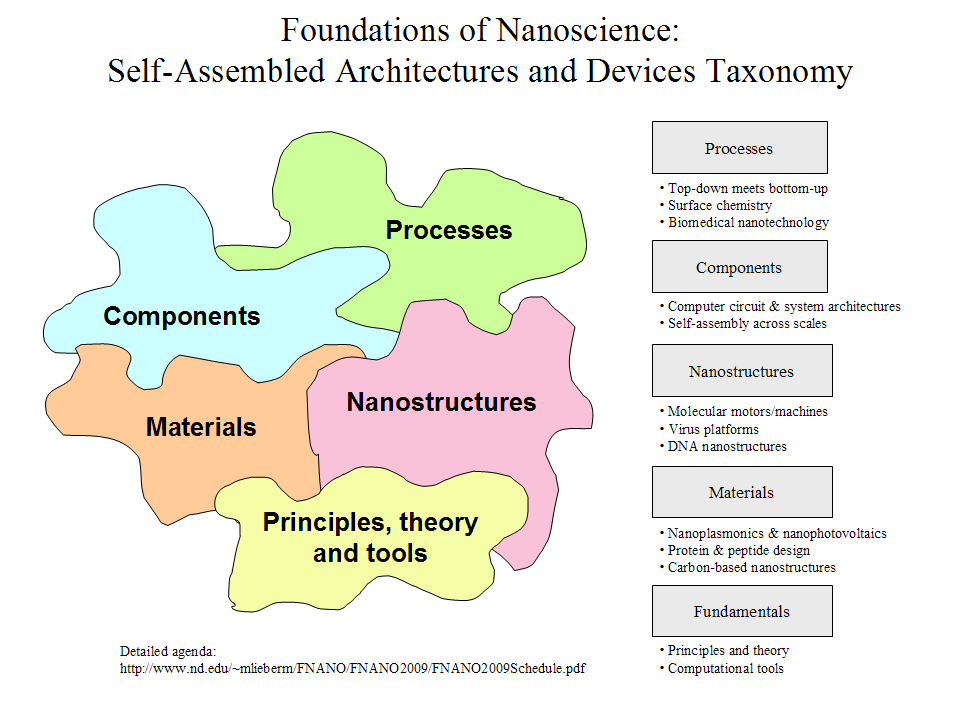
The April 20-24, 2009 Foundations of Nanoscience conference at Snowbird UT provided an interesting look at the wide variety of subfields and applications for nanoscience in thirteen tracks roughly organized into five areas: principles, materials, nanostructures, components and processes (Taxonomy, Quick Reference Guide to Current Research). Many of the nanoscience subfields have been in existence for five to ten years, however the different nanotechnology science and commerical efforts are still fairly isolated (for example, there could be an NNI roadmapping initiative). Nanoscience is largely still at the stage of experimental demos rather than quick advances to commercialization. The diversity of approaches demonstrates creativity and the increasing complexity, refinement and sophistication signals that nanoscience could be moving into a more mature era.

Definition and applications
Nanoscience is the interdisciplinary nexus of several fields including chemistry, physics, electronics, biology and materials - a convergence hub between life and technology, organics and inorganics, biotic and abiotic, top-down engineering and bottom-up nature. Researchers exhibit substrate agnosticism as approaches, techniques, tools and applications may be organic, inorganic or synthetic; the focus is on properties, functionality and requirements.

Nanoscience also encompasses fundamental understandings such as the definition of life, for example, it can be argued that self-replicating crystals constitute organic life. The potential uses of nanoscience are manifold, particularly in electronics, medicine, sensors and materials.

Drug delivery and bridging the gap from end-of-the-roadmap Moore’s Law computing to molecular electronics are the most urgent potential applications.
Figure 1: The End of Moore's Law and the gap between microprocessing and nanoprocessing

The central issue is working with today’s top-down engineered approaches which are specific but limited, to reach the molecular scale, by either extending existing methods or integrating or substituting them with molecular (organic) methods. Biology is a molecular system that works, in fact many interlinked systems. While it is messy to characterize and direct, it has tremendous potential both in its existing mechanisms and novel constructions. However, new materials and processes could be challenging to bring into the existing electronics fabrication value chain.

Status: increasing complexity and working with trade-offs
Broadly, nanoscience is currently in the phase of building on basic configurations to achieve more complex design motifs, for example scaling up circuit arrays from single to double digits, generating 3D construction materials such as 3D nanocrystals, making molecular motors from biological parts, producing active vs. static building blocks and a variety of structurally strong shapes such as icosahedra and other polyhedra. In addition to increasing complexity, another major theme is the sophisticated design trade-offs amongst a variety of parameters such as chirality, charge, planarity, time scale dynamics, thermodynamics, binding, distance, solubility, aggregation, functionalization and materials.

Wonder tools: DNA and CNTs
DNA and CNTs are the most widely used materials in nanoscience. DNA is a tremendously versatile tool not just as an information carrier and material for building structures but also as an external tagging agent on particles and as a template for directing the growth of nanocrystals and metal wires. As has long been realized, carbon nanotubes have many desirable properties for a wide range of applications but still prove elusive to manufacture to spec in large quantities.

Conclusion: moving nanoscience to nanotechnology
Many fields of science now operate at the nano or molecular scale and it is clearly useful to have a foundational characterization and established toolkit for molecular science. One next phase would be moving nanoscience to nanotechnology, seeing a tight linkage between the emerging novel materials, nanostructures and architectures to the engineering and realization of applications.