 Peer-to-peer micro-finance is expanding from lending marketplaces like Prosper and Zopa to peer-to-peer affinity-driven financial support for a wide variety of arts, humanitarian and software development projects.
The phenomenon has many names: crowd funding, crowd sourcing, social finance (coined here?), and virtual affinity group capital. Crowd funding is the natural extension of memes like the long tail, smart mobs and social networking and is an obvious capability of an increasingly linked online populace. Social finance is Money Now! - instant market support for good ideas attached to validated reputations.
Several websites are accommodating crowd finance: bands via Sellaband (description), movies via A Swarm of Angels, and citizen vlogging via HaveMoneyWillVlog (using a Wordpress plugin) which importantly lists the deliverable(s) and has feedback loops for on-project progress. Austin TX-based Fundable is a clearing house site for social finance and sees many uses for its platform including project financing for individuals, non-profit organizations, relief efforts and software development projects as well as other social finance practicalities such as splitting the cost of purchases and club dues collection. Fundable's beta site is a bit under-built (needs better listing and search functionality) and their 7% fee is steep (Prosper takes 1% of funded loan amounts).
Social finance projects are most often open-source, and are sometimes executed in interaction with the funding sponsors. A minimum contribution of $10 is generally required and the total amount to be raised is a few hundred or a few thousand dollars. PayPal (perhaps finding itself much more extensible than initially envisioned) handles the mechanics of the crowd pledges and fund disbursement, sometimes including some degree of escrow functionality for the commitment of funds and return of pledges if the project does not fully fund.
The funding levels are still fairly low for social finance projects but as the model becomes more proven, hopefully the OpenBasicResearch.org idea could be used for longer-term science research funding and looking out even further, the economy could shift to include freelancers with consistent regular affinity support as dependable sustenance.
It is exciting to see the power of virtual affinity groups in providing capital in both lending and grant financing models. The next obvious capability of virtual affinity groups will be in providing political support. The impact of social finance, text and video blogs and video clip websites like Blip.tv and YouTube will likely be significant in the 2008 presidential elections.
Monday, September 25, 2006
Social finance has arrived with crowd funding
Saturday, September 23, 2006
Vlogging democratizes and extends citizen media
 The small media revolution started with blogs and podcasts and further continues with the currently exponentiating vlogs.
Programming is now fully democratized; people can create whatever programming they think is interesting, relevant, entertaining, creative, has a message, etc. and distribute it for free on the Internet (courtesy of broadband) to affinity audiences who find the posts by interest linkage not mass-marketing. In addition to superstore vlog aggregators Blip TV, YouTube, Dave TV, Current TV, etc., special interest content development and aggregation new media companies are already emerging such as Have Money Will Vlog. Foundation grant funding for digital media community projects is also available. As with blogging and podcasting, monetization models remain hazy; advertising models are still grappling with blogs, (Google take note) unobtrusive effective video-based advertising is still pre-infancy.
With vlogging, the viewer creates the programming; life-chronicling (life-blogging, my life in bits (overall description, microsoft), etc.), interesting, entertaining, relevant programming for friends, family, employers, special interest groups, documentaries and broad political, economic and social statements. Like the rise of political blogs, vlogs will likely have an important irreversible role in the 2008 US presidential elections. At first blush, vlogging, like blogging, might seem egotistical however it is really about creativity, expression, storytelling and agenda accomplishing.
With video capture as a standard feature of today's mobile devices, we can all be citizen journalists anywhere anytime, which means we must expect that others are doing so of us and makes us wonder what obligations and costs, as in Josh Wolf's case, this new power confers. Vlogging is just like blogging and podcasting only even easier to create and more accessible to both creators and viewers.
One result of the explosion in citizen media is that the world is increasingly balkanized into media zones by age tier:
Group 1: newspaper, standard TV, radio and written correspondence
Group 2: traditional Internet news sites (nytimes.com, Google news), Tivo-controlled TV and user-driven XMSR and Sirius satellite radio and email
Group 3: Blogging, vlogging, commenting, linking, aggregation readers, in-game and in-world chat, texting and mobile platform domination
Group 2 "decides" whether to blog or vlog, Group 3 just does. The medium is the message: popular media is finally popular. Vlogging is about the fun, challenge and responsibility of making media. Vlogging, blogging and podcasting are all open platforms. Everyone needs to explore for themselves how they want to experience and create on that platform. Your message is your content in that medium.
Tools:
-Vlog pioneer Ryanne Hodson's comprehensive free tutorials: FreeVlog.org
-There are many convenient vlog readers (which are also blog readers), particularly FireAnt and open source Get Democracy, which can be used to search, subscribe and manage vlogs.
-There are a wide variety of vlogging techniques including: traditional video capture and editing, photo-casting - snapshots linked with or without audio using tools like FilmLoop, Slide and BubbleShare, screen-casting for machinima, and good ol' Flickr for quick visual images.
Friday, September 22, 2006
AGI survival instinct
 In the future digital world of human software file uploads and AGI, the primary entity may elect to run a variety of other versions of itself for experimental, improvement, productivity or other purposes.
How will these non-primary entities view their survivability? David Brin's "Kiln People" has a convenient answer to an analogous situation; his "dupes" are not able to live more than 24 hours. Some argue, as does Lee Corbin, that any non-primary entity should and would be happy with any run-time, no matter how minimal and would happily accede to termination at any point if that were the wish of the primary entity.
It is quite possible that an instance would not want to terminate for at least two reasons:
1. Evolutionarily, survival is one of the most basic and primary instincts of a being and it would seem hard to divorce this from an entity even if it has multiple instances running. It would also be impractical to attempt to edit survival out of the additional run-time versions.
2. As with AGI relative to current humans, subsequent digital entity versions once running may be evolving exponentially faster than the original and could develop capabilities that the original instance could not understand and control. The usual arguments that humans use to become more comfortable with the potential superior intelligence of AGI - to run the AGI or other instances slower or in a more contained resource environment - are just as unlikely to work in this case.
If the subsequent instance is sufficiently different from the original, and the original is not likely to update itself to integrate these differences, the subsequent version might well view these differences as important, personal and unique improvements and wish to preserve itself, even to the logical extreme of attempting to destroy the source code of the original instance.
Wednesday, September 20, 2006
Anousheh - they should be paying her $20 M
 Anousheh Ansari, the International Space Station's fourth civilian space explorer or space tourist, may just be using the visit as the next stepping stone in her continued contribution to the commercial space industry. She is pictured at right on the ISS, blogging and doing email, just as on Earth and here is the picture that will sell a thousand space flights.
Ansari sponsored the Ansari X Prize with Peter Diamandis which has turned into the multi-event annual X Prize Cup and her commercial space venture capital activities include twenty sub-orbital space craft on order from Russia. Ansari-sponsored companies may join Virgin Galactic in offering commercial space flights from Spaceport America in New Mexico which is scheduled to open for commercial space flights in 2008. The current status of the spaceport is that an FAA environmental study is in-process and due to be completed by the end of 2006 after which construction could begin.
At minimum, Ansari is helping space travel to become more routine in the minds of many and as a pioneer and entrepreneur; hopefully she is thinking about how to make space exploration cheaper, more accessible, quicker and more comfortable for the hundreds that will follow. More than the other civilian space explorers to date, Ansari is positioned to extend her experience into a broader opportunity.
Saturday, September 16, 2006
1 billion mobile devices to be sold in 2006
 Already pressured about no longer being on the Moore's Law curve (the Pentium 5 being at 2 year doubling times) and distracted by Microsoft Vista's impending arrival, the computing industry is further stymied by the boom in mobile devices (1 billion units to be sold worldwide in 2006) vs. PCs (250 million units to be sold worldwide in 2006).
PCs or Computing (servers, desktops and laptops) have always driven industry design roadmaps. Now semiconductor and other vendors are struggling to assess whether and how to adapt their design processes for the increasingly divergent exigencies of computing, networking, gaming and mobile devices. A variety of chip and systems level designs are proliferating across the supply chain which could drive innovation and improvements but could also entail friction and complexity and in any case are too early for significant positive results to be reaped.
In the memory segment, NOR and NAND's mobile device focused growth is due to overtake that of general computing's mainstay DRAM. New memory solutions discussed at last week's San Jose CA MemCon are also in the offing such as solid state hard drives (expensive and less-proven technology) which would allow quicker machine booting and application loading and a variety of hybrid hard drive solutions including Intel's Robson interface (a closer extension of today's technology).
The computing industry is traditionally-minded, cloistered and responsive vs. visionary; a behemoth focused on managing complex integrated global supply chains with long product design and life cycles ($25 million average chip design costs) and not meta-level change.
The biggest risk is that despite rampant demand and wireless broadband proliferation, the computing industry continues to dismiss mobile devices and ignores the real potential power of the mobile computing platform.
Sunday, September 03, 2006
Virtual Killing
 Until human brain files can be uploaded, and/or AGI and avatars can make a convincing case that they are conscious, the extinguishing of virtual characters cannot be considered killing, murder or homicide but rather the destruction of personal property.
Even once there are uploaded human software files and other conscious electronic entities, destroying a run-time instance would still only constitute property damage. Not until all backup instances of source code were destroyed such that the entity could never run again could the physical world concepts of murder, homicide and suicide start to be introduced in the virtual world with any seriosity and legal consequences.
With real-time backups updating saved instances, destruction of run-time instances cannot be more than crimes of property destruction. Many interesting situations could arise such as a run-time instance discovering and reacting to a plot to expunge its source code, or an electronic entity experiencing accelerating evolution and wondering how much to update its original source code; would you want a copy of your four year old mind file?
Monday, August 28, 2006
Les Nouveaux CyberCelebs
 The world is changing. It has always been the case in TechLand but never before has there been so much mobility and opportunity for impact and name-making.
New CyberCelebs emerge every day largely by dint of being there first, by being early users of a new medium or area or product and as things are moving so fast, finding themselves de facto experts whose opinions are sought. CyberCelebs are most often not formally educated in the underlying aspects of their substrates (e.g.; psychology, art, composition, game design, economics, politics, etc.) or sometimes even at all.
Some notable CyberCelebs include Julian Dibbell (gaming economies), Jerry Paffendorf (metaverse worlds) and Robert Scoble (blogging).
That the new experts are not those schooled in underlying principles, but early experiencers of the milieus suggests that:
1) there is tremendous opportunity for anyone to have impact in world-shaping and making a name for his/herself
2) formal education can but slip farther behind in preparing anyone for the world of accelerating technological change. Unfortunately something seems to be missing from both sides, traditional education is anachronistic and irrelevant, and TechLand misses by being homogeneous and narrowly focused.
The best way to be a participatory citizen of today is to splice a self-study program of traditional education with learning new areas though direct experience and blogs.
Tuesday, August 22, 2006
Personalized Virtual World Views
 Metaverses (metaversi?) are proliferating, from Project Entropia to ActiveWorlds to Blaxxun's 15 communities to There to Sims Online to Second Life (whose residents have more than quintupled since the beginning of the year, especially since credit card identify (and age) verification is no longer required as of June 30).
MyWorld
However, these early metaverse worlds carry in too many incongruous metaphors from the physical world. One is not making use of VR to change the concept and physical layout of space. It should be possible for users to personalize by choosing a profile for the sims (properties/mini-sites) that will display in their virtual world views, at minimum with ad-blocking. The Berners-Lee Internet, in 2d or 3d, is about pull not push; users should have the right to populate their own attention flow streams.
With teleportation being the navigation method of choice, there is no requirement (or detriment to virtual real estate markets and traffic) that sims/locations be contiguous or in any static formation. People visit locations they prefer in virtual worlds anyway, personalized views is merely a facilitation tool that could also lead to greater creativity in developing and using the metaverse world medium.
In addition, personalized virtual world views could help with the zoning, local government, and enforcement growing pains that were expressed at last weekend's second annual Second Life Community Convention.
Imagine logging in to a virtual world and finding sims in your interest profile grouped all around you (possibly above and below as well), showing in different light tints or colors per parameters; a new and growing VR smorgasbord with each visit. View preferences could be changed at any time and could be set to "all" or "random" or even the meta metaverse channel.
As with cell phones, multiple environment profiles (with customized avatars) could be stored for easy access to professional collaboration, education, information gathering, hobby #1, hobby #2, sexchat, etc. Multiple full or partial avatars with simultaneous existence can hopefully be realized soon.
Thinking ahead to business and military applications, flexible user profiles would also allow different hierarchical (meta) tiers and permissioned views of virtual sites/information. There are many ways the property of spatial flexibility can be used to improve and extend the use and value of metaverse worlds.
Monday, August 14, 2006
Making money in video games - ethical?
 Is it ethical to make money in online video games? That is by spending video game time earning gold pieces or other game valuables and currency through patient monster slaughtering and skill/trade acquisition (skinning slain beasts for pelts). The gold can later be converted to physical world currencies at game trading sites like MarkeeDragon or eBay or by trading with other players.
Anachronistic economic imperative persists
Despite general resource abundance and continually increasing efficiency of matter usage, there is a diminished but still present economic imperative in the physical world; it is necessary to earn or have some degree of money to provide for survival needs. Given the economic imperative, the rational being will find the most expedient means of meeting this requirement and would certainly consider video game income generation as an option. If one can make the same or more money in less time in a video game, why not do it! And many are, from MMORPG gamers to Second Life metaverse merchants.
Is video game playing a potential career?
Some might dismiss video gaming for income as a dull routine of repetitive tasks, hmm...which sounds exactly like...most physical world jobs. Gaming has many benefits including allowing one to set one's own hours, providing a clear means of status and progression up the hierarchy and the ability to choose the degree of partnership with others. Again, why not cover expense demands via gaming and pursue other projects and interests with the rest of the time saved by not having a regular job.
Parasites?
By parallel, stock market traders have been denounced as parasitical for not making real and tangible products but living derivatively from the efforts of others. In reality, investors provide liquidity and take risk, without which financial markets would not exist. Video game income earners are the same; they could also be accused of being parasitical but in reality are providing the liquidity which makes virtual markets work and in addition are facilitating the transition and advancement of humans and intelligence to the machine substrate.
A large class of humans is growing that is comfortable with a variety of physical world and virtual world activities for a wide variety of purposes ranging from social to creative to income generating. Video gaming skills and knowledge often translate back to physical world activities too, who doesn't list their WoW Lvl 60 Mage 200 person raid-leading skills on their resume?
There is the usual tired argument that what if everyone wanted to make money in video games, who would make the "real" physical world stuff? Well, not everyone has become financial traders, so presumably not everyone would seek to earn their only income in video games, also with the likely increases in robotics and molecular manufacturing revolutions in materials, the world of stuff will continue to occupy fewer and fewer people.
Future of Transactions: Virtual Affinity Groups
There are already many virtual markets, including financial, prediction, eBay, P2P lending, MMORPG and metaverse worlds to name a few, and the type and nature of virtual markets will continue to grow. The Internet is awash with social liquidity that will likely be directed into Virtual Affinity Groups that self-assemble for the purpose of economic, political, etc. transactions.
Tuesday, August 08, 2006
Five years to Chinese economic domination
 Applying the CIA Factbook's 2005 growth rates to GDP numbers and extending for several years suggests that China's GDP will have surpassed that of the US by 2011 (in less than five years) when both countries will have GDPs of about $15 trillion. Of course it is expected that China's torrid 9.9% growth rate will slow, and China may be more prone to reporting errors but the trend to economic dominance role reversal is clear.
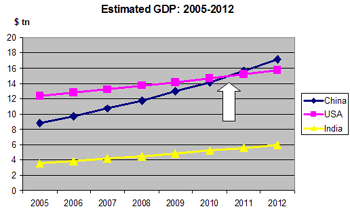
In 2005, the US had a GDP of $12.4 trillion and a growth rate of 3.5% and China had a GDP of $8.9 trillion and a growth rate of 9.9%. Developing world peer India starts with a lower base ($3.6 trillion in 2005) and has a healthy 7.6% growth rate, but is not forecast to catch up to the US and China in the next decade, if linear growth persists.
Interestingly, the arena for China's growth is not limited to the traditional, physical world of GDP; the more important Chinese economic dominance may be in digital worlds. Merely the opening act features China as already a huge participant in the digital economies of metaverse worlds like Second Life and Internet gaming by manning and sometimes creating and improving bots to mine gold and other MMORPG video game valuables.


 Email me
 Twitter
 Subscribe to blog
 MS Futures Group
 Data Visualization Wiki
 Economic Fallacies