Sunday, February 24, 2013

Big Data Era: Not just More Data but New Kinds of Data

One aspect of 21st century data literacy is realizing that there is not just more data, but also that there are new kinds of data.

There is a significant shift from the model where ‘all data is salient,’ for example, each entry on a calendar is a relevant appointment, to a model of being able to recognize different kinds of data and appropriate actions related to specific data types. The focus level upshifts to the correlation, trend, and anomaly level of big data abstractions rather than on the unitary level of the data flows themselves.

Daily quantified self-tracking data for example may be useful from a longitudinal perspective and might not need to be reviewed unless there is an anomaly. Another example is that the relevant action might be looking for correlations across multiple data streams. There could be potential linkage between coffee consumption, social interaction, and mood per as this Sen.se multiviz project investigates, finding some correlation between social interaction and mood. 

Discussed at greater length in: Swan, M. Sensor Mania! The Internet of Things, Wearable Computing, Objective Metrics, and the Quantified Self 2.0. J Sens Actuator Netw 2012, 1(3), 217-253.

Sunday, February 17, 2013

Polyamory – an Anti-Scarcity Relationship Model for the Future

The first International Academic Polyamory Conference was held in Berkeley CA February 15-17, 2013 with approximately 100 attendees. Polyamory is the practice, desire, or acceptance of having more than one intimate relationship at a time with the knowledge and consent of everyone involved. It is not new or revolutionary that individuals may be involved with more than one other party; what is new is the openness, acknowledgement, and support and encouragement of the situation.

A number of academic studies were presented by researchers from around the world regarding the practice of polyamory. Polyamory is a niche, but increasingly becoming a defined field of sociology research. Theory papers and discussion drew on social movement theory, queer theory, intimacy theory, performance theory, and other aspects of philosophy and sociology. Other conference tracks discussed public education, experiential aspects, and legal and political issues. Some common themes were the notion of plurality and choice in relationship models and a superior level of communications mastery and emotional intelligence.

Plurality of Relationship Models 
There may be many relationship models aside from traditional normative monogamy. One only has to look at the fluidity and nuance in the reality of lived existence to see different kinds of relationships. There is the notion of bringing other relationship models into the light for greater legitimacy under the umbrella that would include monogamies and non-monagamies. Any individual may have an almost endless stream of potential demographic self-identifications to make in the categories of Race, Ethnicity, Religion, Gender, Sexuality, Relationship Model, and other categories. Each category has a plurality and range of possible answers and it would be considered discriminatory and inappropriately normative to privilege any specific identification.

Emotional Mastery 
There may be a belief that polyamorous individuals have a silver bullet and do not experience jealousy and other challenging emotions often occur in relationships. This is not at all the case. The polyamory community has not mastered jealousy, but it is often true that individuals are in trying on an ongoing basis to master communication with the self and others. Individuals in polyamorous relationships may have more experience, permission, and tools at their disposal for recognizing, acknowledging, and managing jealousy and other emotions that arise in human relationships - poly people may be more skilled at dealing with the situation.

Sunday, February 10, 2013

Core 21c Skillset: Data Literacy

A core 21st century skillset is data literacy, meaning the ability to recognize, understand, and manipulate various forms of data. One way is through visualization, using visual techniques to both represent data, and also as an inquiry tool for finding patterns.

Some of the basics of data visualization are being able to distinguish between ordinal (qualitative) and quantitative data, and selecting corresponding plotting techniques. For example, a bar chart may be best for displaying simple quantitative and ordinal values, a scatterplot for multiple quantitative data values, and a shape-based plot chart for multiple ordinal values.

Beyond the basics, the next step is mastering more sophisticated visualization techniques. Some of these build on information visualization pioneer Edward Tufte’s work and include using small multiples (plotting several similar charts to highlight differences in one variable), bullet charts, sparklines, horizon charts, and adding a dynamic element to visualizations.

Sunday, February 03, 2013

Quantified-self Experimentation Platforms

In the burgeoning Quantified Self (QS) movement, one recent trend is the emergence of tools explicitly for the conduct of QS experiments, either individually or in groups. These tools offer the rapid design and launch of experiments, and usually some degree of automated operation, data analysis, and recruitment.

On the mobile platform, there is PACO, the Personal Analytics Companion for the design and operation of private or shared personal science experiments. Another tool is studycure, an online platform that allows users to create and run interactive experiments using simple if/then logic to help users design experiments.

Community self-experimentation networks also exist, such the health collaboration community Genomera where professional researchers, non-profit groups, and individuals run studies examining a range of issues such as sleep quality, vitamin deficiency, microbiomic profiling, empathy-building, and how the memory works.

Sunday, January 27, 2013

Oh, fungibility!

Crowd resource models continue to grow as “on-demand third-party asset rental platforms” become their own sector.

Some of the most familiar names in fungible resource marketplaces are on-demand automobiles (ZipCar, Getaround, and Uber), apartments (AirBNB), and local marketplaces for physical-world task outsourcing (TaskRabbit, ViaTask), products (CraigsList, Peddl), and services (Zaarly - e.g.; cooking, organizing, personal training).

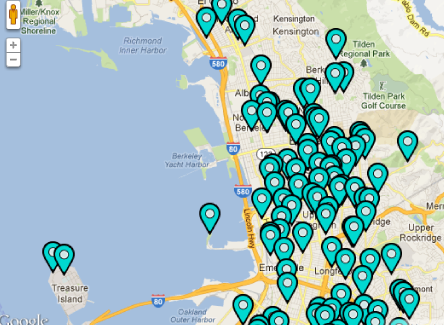
Some nice new verbs could arise like "I AirBNB’d my house, and I getaroundt or getarounded (grammarians?) my car." Payment structures are emerging to support third-party asset rental, stalwart models like Paypal and newly-launched Flattr (social micropayments) - "Just flattr me that dinner payment..." Other neologisms are needed for new situations like where you list your asset only to find a market surplus already exists in your area, like the over 400 user-owned Getaround cars currently available in Berkeley CA (Figure 1). The 'amazonification' of pricing is also an issue as the market may be flooded already with similar items and how low are you willing to go to price your asset.

 Figure 1. Over 400 Getaround cars available in Berkeley, CA!


Future Implications
Third-party asset rental is a nice intermediary step towards other imaginable near-future scenarios like on-demand driverless transportation pods and portable housing through mobile airsteading modules. Soon enough, some level of resources may be automatically fungibly allocated without human intervention.

Sunday, January 20, 2013

Quantified Self Uplevels to Quality of Life

The quantified self movement has barely gotten going in the last five years but contemporary shifts can already be seen such as the idea that the current activity is just an intermediary node on the way to the future exoself.

The quantified self refers to any individual engaged in the self-tracking of biological, physical, behavioral, or environmental information, often with a proactive stance towards action. At the center of the quantified self movement is, appropriately, the Quantified Self community with thousands of worldwide participants.

Quality of Life
A key contemporary shift is a push beyond the basic self-tracking of ‘steps walked’ and ‘hours slept’ to examine more complex qualitative phenomena like emotion, happiness, and productivity. The overall objective is to improve the quality of life.

CalmingTech
One example of improving the quality of life is by using ‘calming technologies’ to reduce stress. Whereas technology generally seems to speed things up, calming technologies do the opposite, helping to slow down and de-stress life.

The Calming Technology Lab at Stanford designs solutions to identify stressors, and respond to them by evoking a state of restful alertness in the individual. Calming technologies draw on the general principles of behavior design, where three aspects are required to produce a behavior change: sufficient motivation, sufficient ability, and a trigger. Calming technology is essentially a quantified personal stress management system.

Core Calming Principles
The CalmingTech lab has suggested ten core design principles to use in creating calming technologies, including reducing feelings of overwhelm, and having the ability to control interruptions. 

NewTech, ArtTech, CalmingTech…what could be next? HumorTech? SerendipityTech? 

Sunday, January 13, 2013

How to be a Philosopher

One of the great values of philosophy is that it can be a helpful tool for thinking through any question of deeper puzzlement. Philosophy is needed now more than ever in a world that seems to be changing quickly, and the field could enjoy a renaissance in wider popular application. The practice of philosophy need not be confined to experts but is accessible to all. Here is a short-list of how anyone can be a philosopher:

Level 1 
  • Study the ancient texts 
  • Claim a new read on the old texts 
  • Claim that no one understands what [old philosopher #1] really said/meant and explain it yourself
Level 2 
  • Find basic concepts in philosophy that no one has really thought through yet such as performativity ("...really performativitie...") Examples: Heidegger’s being and metaphysics, Deleuze’s difference 
  • Invent strange neologisms (really neo-spellisms) by spelling existing words in new ways that no one can understand, and use them brazenly without definition: “…this is to say not just Possibility Space, but really Possibilitie Space…” or "the conceptologie here..." Examples: Heidegger's existens and phenomenologie, Deleuze's differance and differenciation, Derrida's linguage
  • Invent new compound word combinations: "...the singularity of the self-other and the plurality of the group-crowd..." Examples: Foucault’s power-knowledge, Heidegger’s standing-reserve 
Level 3
  • Submit a paper to a philosophy conference with a title like: "Rethinking [ancient philospher]'s [important concept] in [modern philospher #1] and [modern philosopher #2]"
  • Offer a critique of the history of Western philosophy and propose a new/real metaphysics (examples: Heidegger, Deleuze)

Sunday, January 06, 2013

Top 10 Technology Tends for 2013

  1. Big data ubiquity, along with machine learning algorithms, and information visualization
  2. Video is the platform (example: individual YouTube channels with over 100,000 people making more than $10,000/year from ‘home video’ properties like My Drunk Kitchen, the ShayTards, and Right This Minute) 
  3. Wearable computing and objective biometrics: Fitbit, myZeo, WiThings, smartwatch, smartring, wearable electronic patches and tattoos, Google’s Project Glass
  4. Fracking
  5. eHealth biohacking: Quantified Self-tracking, self-experimenting, group health collaboration, $99 personal genomics (23andMe), $99 personal microbiomics (American Gut Project), $5 home blood-test cards (Talking20) 
  6. eLearning: Coursera, Udacity, edX, Class Central (MOOC aggregator)
  7. Mobile is still the platform: worldwide smartphone adoption crosses 1 billion
  8. Crowdsourced labor marketplaces: CrowdFlower, CrowdSource, oDesk, ClickWorker, Mechanical Turk, mobileworks, TopCoder, Elance, vWorker/Rent a Coder, Guru, 99designs, crowdSPRING, CloudCrowd, Soylent, microtask, LiveOps, Gigwalk
  9. Computer security: increasing power of Internet-based activist hacking groups (e.g.; Anonymous)
  10. New economic models (crowd-based): crowdfunding (Kickstarter, indiegogo, etc.), sustainable business, and crowdfunded debt forgiveness (from the Occupy movement’s financial arm: Rolling Jubilee)
Up and coming: Consumer EEG rigs wearable 24/7 (Axio, Interaxon) and attendant neural and biometric data privacy rights, ideally sans Faraday Cage 2.0

Still waiting for: nanotech, 3D printing, eHealth data commons with public longitudinal phenotypic data sets

Predictions for 2012, 2011, 2010, 2009 

Thursday, December 27, 2012

The Mindfulness Meme

Mindfulness is increasingly arriving as an au courant meme to denote a deliberate, relaxed, and enlightened understanding when interacting with the self and others.

Despite occasional blips to the contrary, Steven Pinker (in The Better Angels of Our Nature) seems to be right in citing the overall decline in violence over the centuries of human existence. Even in the shorter term, this is visible in a Google Trends analysis of the keywords 'mindfulness' and 'assault weapons' appearing in news headlines (Figure 1).

 
Figure 1. Keywords in News Headlines 2005-2012: 
Mindfulness (blue) and Assault Weapons (red) Source: Google Trends


Monday, December 17, 2012

What is your SQ?

There was IQ, then EQ, and now, SQ! SQ – spiritual intelligence quotient – is now a criterion for successful leadership.

In the wake of scientific support for meditation and other mindfulness practices, and as businesses in the social capital movement transitioned to triple bottom lines (adding social and environmental outcomes to the profit motive), so too now the paradigm for successful leadership is changing. Empathy-devoid environments are no longer acceptable.

There is a claim that the successful contemporary leader in any field has the triumvirate of intellectual intelligence, emotional intelligence, and spiritual intelligence. Part of 'Spirituality 2.0' is the act of transferring quality-of-life attributes from spiritual practice to mainstream application.

The high-SQ leader has self-mastery and behaves with wisdom and compassion while maintaining inner and outer peace, being present in an embodied way, and connecting with others both intellectually and emotionally.

Top 10 traits of high-SQ leaders:
  1. Calm and centered 
  2. Compassionate 
  3. Courageous
  4. Passionately committed 
  5. Forgiving 
  6. Authentic, walks-the-talk 
  7. Humble 
  8. Wise 
  9. Peaceful, nonviolent 
  10. Service-oriented