 Health 2.0 is about re-envisioning every aspect of health and health care. New business models are starting to develop to support this innovation ecology. First, accompanying the new paradigm of community research (peer cohort studies à la Patients Like Me (lithium) and DIYgenomics (MTHFR mutation/Vitamin B-12 deficiency), could be social venture finance, corporate sponsorship from supplement companies and other remedy vendors, crowdsourced finance (i.e.; Kickstarter), and philanthropist contributions. Second, the traditional venture capital model is already being applied to health 2.o startup companies, including through organizations such as the Health 2.0 Accelerator. Third, whole new industries may sprout from the nascent efforts of health advisors and wellness coaches. The health advisor is the analog to the financial advisor or mortgage broker, able to integrate a client's health data streams, needs, and interests with available offerings, across a spectrum of economic models: insurance reimbursable, HSA dollars, and direct out-of-pocket spending.
Sunday, April 11, 2010
Health 2.0 business models
Sunday, April 04, 2010
Mobile app concept: Disaster Telediagnosis
 Disaster Telediagnosis is a mobile app idea that takes advantage of the bandwidth and mobility of 4G. It is a massively scalable peer-to-peer clearinghouse application providing live streaming video communication between people injured in a crisis situation and remote physicians for diagnosis and ongoing support until hand-off to local health authorities.
Whenever an injured party needs to interact with a physician, anyone with a smartphone can take a picture or stream live or archived video coverage to the internet clearinghouse to be connected in real-time with any available physician worldwide. There may be multiple interactions between patient and physician, both of whom are mobile, over the course of the case, and continuity can be preserved through high-bandwidth video connectivity. The internet clearinghouse could provide language matching or automated translation, and would log all calls based on GPS and other tagging attributes. Remote physicians could review and annotate patient electronic medical records, and the archived video files would provide patient history.
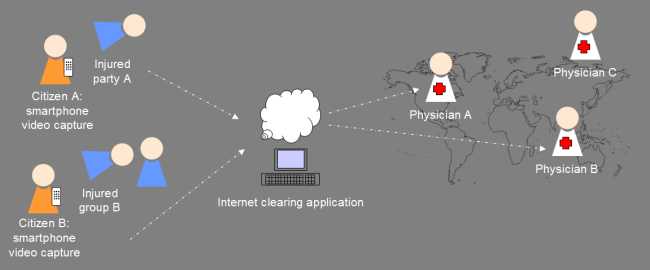 Any citizen with smartphone video capture could record injured parties describing their conditions, or otherwise document the status of the injured or dead. Video is streamed to the internet clearing application and on to available physicians, possibly with specialized language capabilities.
This application concept is accepted for presentation, if a demo can be realized, at the Clear 4G Symposium at Stanford in Palo Alto, CA, June 15, 2010; any interested developers and collaborators please contact the author.
Sunday, March 28, 2010
Future of Crisis Management
 At the CMU-hosted Silicon Valley Crisis Camp, March 26-28, 2010, there was a lively brainstorming session about the longer-term future of disaster management. In the much farther future, crisis response could disappear since disasters might be prevented through weather management, sensor-equipped smartbuildings, and floating movable cities. When disasters do occur, they could be regarded as an annoyance rather than a catastrophic loss of human lives and property through the 3-D printing of physical bodies imprinted with recent mindfile backups, and robot-aided damage clearing and structure rebuilding.
In the medium term, advanced technology could transform crisis response in several ways:
- Robotic first responders: Autonomous or remote-piloted robots could be used as a substitute to humans for assessing damage, scouting terrain, finding victims, and providing aid.
- Super-smartphone: Super-smartphones could be messaged or would automatically sense disaster occurrence and switch into crisis mode, making disaster applications easily accessible, for example mapping software layers indicating relief shelters, and automatic status updates from personal social networks. Smartphones could track health status, vital signs, psychological state, and be used for telediagnosis and even possibly DIY surgery or other medical treatment. The user could run a virtual world app on the smartphone integrated with augmented reality to send their avatar out to inspect the local environment for self-rescue and peer-rescue.
- Building codes 3.0: smart sensors could capture a variety of data about a building’s status and its occupants, for example knowing who or at least how many people are inside a building at any time (with regular data purges to protect privacy).
- Gaming: An augmented reality (AR) game immediately begins when a crisis occurs. Participants earn points for crowdsourcing/reporting information, uploading video footage documenting damage, and accepting challenges (disaster management-related tasks). There could be many layers to the AR interface, heatmaps showing the injured and dead, building damage, resource availability, shelters and health clinic locations. Gaming could be used to pass time, distract, improve psychological state, and connect those in physical proximity.
- Market principals: Technology tools could be used to create markets, to facilitate the discovery and exchange of different types of supply and demand: information, labor, time, relief resource availability, and distribution.
- 3-D printing of relief materials: blankets, food, shelter, medical supplies, and clinics could be printed with 3-D printers and online sharable CAD designs in urgent disaster response. Over time, smart infrastructure printing could be used to reconstruct buildings. Rubble could be recycled into building materials.
- RFID-tagged resources: all aid resources and donations could be RFID-tagged for inventory management and delivery, including real-time updates of what is still available and functional from local stores; markets could develop to allocate resources.
- Personal biosensors and bioactuators: personal biosensors are seamlessly incorporated into clothing to provide a personal data climate including both biophysical and environmental data. Biosensors can identify an approaching bioplague, download antibody plans from the internet, manufacture, and administer them. Similarly, radiation-resistant genes found in extremophiles could be downloaded and applied in the case of nuclear incidents.

Sunday, March 21, 2010
Semiconductor roadmap updates
 The working group documents and presentations are now available from the most recent International Technology Roadmap for Semiconductors (ITRS) 2009 Winter Conference held December 16, 2009 in Hsinchu City, Taiwan.
One of the most important updates from the ITRS 2009 meeting is a shift out in the time scale for the next expected computing nodes. There is a focus on both FLASH memory ½ pitches and the usual DRAM ½ pitches as smaller nodes are expected to be achieved with FLASH before DRAM. Specifically for FLASH, 22 nm is estimated for 2013, 16 nm in 2016 and 11 nm in 2019. For DRAM, 32 nm is estimated for 2013, 22 nm in 2016, and 16 nm in 2019.
An important architectural shift is underway for packing more transistors onto chips: moving from planar to multidimensional architectures. Another big industry focus is in implementing 450 mm wafers for chip manufacturing, up from the 300 mm current standard. (Figure 1)
 Figure 1: One of the world's first 450 mm wafers
In lithography, a key bottleneck area, the two main technologies that will probably be in use for the current and next few nodes are Extreme Ultraviolet Lithography (EUV) and 193 nm immersion half pitch Double Patterning. EUV is less expensive. For later nodes (22 nm, 16 nm, and 11 nm), EUV and double patterning, together with ML2 (maskless lithography), imprinting, directed self-assembly, and interference lithography may be used.
An important challenge is the top-down (traditional engineered electronics) meets bottom-up (evolved molecular electronics) issue of how nodes 15 nm and smaller will be designed given quantum mechanics. The Emerging Research Devices (ERD) and Emerging Research Materials (ERM) working groups presented some innovative solutions, however the majority of the roadmap focus is on the nearer term, the next couple of nodes.
Sunday, March 14, 2010
Neurotechnology taboos
 There is a claim that the magnitude of change that could eventually be possible with neurotechnology makes it different from other technologies. Those who choose not to buy cell phones may not be able to communicate in certain situations, but those who choose not to adopt cognitive enhancement may not be able to participate meaningfully in society.
This claim has already arisen with regard to smart drugs, that school and work environments have become so competitive, that it is not possible to compete effectively on an unenhanced basis. Professional baseball has been a prominent example of the enhancement issue, where enhancement is illegal, yet widespread. Like many other technology rollouts, and particularly given the sensitivities regarding neurotechnology, it could be that incremental tiers of pathology cures become well-grounded before being extended slowly for enhancement purposes. Legally, in certain nation-states, that is.
Philosophically, it could be queried whether mental health is any different than physical health. Humans and societies may not be able to think objectively about mental enhancement given taboos.
Sunday, March 07, 2010
Genomics: progress in exomes and structural variance
 The fast rate of progress in many areas of genomics was the most salient dynamic of the Future of Genomic Medicine III conference at Scripps in San Diego CA, March 5-6, 2010. Cancer genomics and pharmacogenomics continue to blossom as wide-ranging fields of applied genomics. Aging and genomics, and the role of genetics in studying disease and the microbiome are nascent and growing. Importantly coming to the forefront for the first time is structural analysis and exome analysis.
Structural analysis of genomes concerns copy number variation (multiple copies of genes), inserted genes, deleted genes, inverted genes and other structural changes, and is found in all classes of traits and disease. There is thought to be 12% structural variation between humans as opposed to 0.1% SNP variation between humans. SNP variation is the 'typos' at specific genetic locations where the normal nucleotide combination is 'AA' and some people have the risk alleles 'AT' or 'TT.”
Using exomes (the 1-2% of the genome that contains protein coding regions) as a cheaper alternative to whole human genome sequencing, and conducting basic SNP analysis together with more complex structural variation analysis, and possibly methylation analysis (which genes are blocked from expression), and RNA transcriptome analysis (levels of DNA expression), could bring more sophistication to DNA analysis for myriad purposes including pharmacogenomics and disease analysis.
Some interesting startup companies are starting to realize these new aspects of genomic medicine:
- Cellular Dynamics, Madison WI (human cells derived from induced pluripotent stem (iPS) cells)
- Integrated Diagnostics, Seattle WA (predictive blood assays of organ-proteins; UCLA melanoma clinical trial)
- Population Diagnostics, Melville NY (copy number variation analysis for pharmacogenomics)
Sunday, February 28, 2010
Human microbiome and personalized medicine
 In genomics, the eleventh annual meeting of Advances in Genome Biology and Technology (AGBT) was held February 24-27, 2010, and featured an eclectic mix of new research and bioinformatics tools. Genomic research was presented in a diversity of areas including human, animal, plant, and bacteria. Many research advances are coming from partnerships between one or more academic research teams together with commercial entities. The biggest buzz was around Pacific Biosciences, the 3rd generation sequencing darling, with their single-molecule real-time (SMRT) platform which is still on track for an estimated launch later this year. The platform could deliver a 30,000-fold improvement over current methods, and ultimately achieve sub-$100 whole human genome sequencing. Attendees were also wowed by 454 Roche’s bench top GS Junior System (initially announced in late 2009), making sequencing much quicker and easier, and priced at only $98,000 (a milestone for sequencing equipment which usually runs in the several hundreds of thousand dollars).
Sequencing data storage and transfer costs continue to increase with the computing industry still not cognizant of the whole new era of data processing and communications transfer that is necessary for Very Large Datasets. The NIH 1000 Genomes project, for example, is transferring many terabyte-sized files per day.
From a research standpoint, some of the most activity is in cancer genomics. A recent NIH study generated 100TB data sequencing a melanoma sample and a normal blood sample and has been refining the Most Probable Variant (MPV) Bayesian analysis method used to identify genetic mutations. Perhaps the most innovative new research activity is in RNA sequencing. Other specific findings of note are in the areas of the microbiome and genetic variation:
Human microbiome
The complex interactions between individual humans and their microbiomes could have a substantial impact on personalized medicine. In some cases of infectious disease in humans, the pathogenesis may be unknown 40-60% of the time (e.g.; respiratory disease, skin disease). Even rudimentary issues remain unsolved, for example, it may be undetectable from a simple blood draw showing staph infection whether the bacteria was on the skin surface or in the blood. Microbiome sequencing is allowing the identification of novel pathogens, and could also be useful at the human population level to assess the spread and mutation trajectory of pathogens.
Genetic variation: human and otherwise
The populations analyzed in human genome wide association studies are being expanded, with important findings for both ancestry reconstruction and medical genomics. Research was presented on African-American, Mexican-American, Bushmen, and Bantu genome studies. A deeper understanding of genetic variation is also being used to facilitate the selection of desirable qualities in agriculture and animal livestock. For example, a chicken sequencing project found 7 million unique SNPs, 5 million of which were novel, and several of which were useful in translational application.
Sunday, February 21, 2010
Technology shapes man or man shapes technology?
 An interesting philosophical question to probe is the nature of technology. One view is that technology is simply tools that humanity has created to further its will, to enable and reinforce human nature and evolutionary tendencies. Another view is that there are places of crossover, where technology can actually change humans, human nature, and biological drives, both unintentionally and by design.
In the contemporary era of exponentially growing technologies in multiple fields, it is critical to understand what sorts of impacts different technologies may have. One analysis framework is to group technologies by those which could have an immediate direct influence on human morphology, and those that would not. For example, there could be the rapid advent of significantly more dramatic technologies than have been experienced to date. While these new technologies could change some aspects of life, human biological drives could remain unchanged, and therefore the structure and dynamics of human societal organization, interaction, and goal pursuit could also remain unchanged. Some examples of these advances could include the realization of molecular nanotechnology, quantum computing, cold fusion, and immortality. Even with several of these technologies implemented, in the seemingly different world of a post-scarcity economy where material goods and energy would be essentially free, humanity could still be ordered around the same familiar biologically-driven goals.
The other group of technologies is those which could possibly have a near-term impact on the structure and form of what it means to be human. The area with the greatest possible change is improving human mental capability. There have been several significant advances in a variety of neurology-related fields in the last few years that if ultimately realized, could potentially alter human morphology. Even the resolution of all mental pathologies such as Parkinson’s disease, depression, stroke rehabilitation, and addiction would constitute morphological change at a basic level. Augmenting cognition and deliberately managing biophysical states would constitute morphological change at other levels.
Sunday, February 14, 2010
Mental enhancement through neuroimaging
 In The Neuro Revolution, Zack Lynch contends that there is a coming revolution in neuroimaging technology that could be on the same order as the industrial revolution and the information revolution.
1. Neuroimaging for truth detection
Perhaps the most important application area for neuroimaging is truth detection. According to Joel Huizenga, CEO of NoLieMRI, the annual worldwide market is $36 billion for truth verification. The U.S. government does 40,000 lie detection tests per day, and the Supreme Court acceptance standard is results that have a 95% chance of accuracy. Businesses buy 400,000 tests per year, some of which only have 50% accuracy. FMRIs are much better lie detectors than current tests. Mechanically, more blood goes to other parts of the brain which are related to deception when someone is lying. Explicit lie detection is one demand area but truth verification is much broader. The notion of brain fingerprinting can be used to detect the presence or absence of information in the brain, for example testing knowledge of crime scene details.
2. Neuroimaging for mental illness assessment and rehabilitation
A second important application area for neuroimaging is mental illness identification and rehabilitation. A government-sponsored survey published in 2005 found that almost half of Americans meet the criteria for a mental illness at some point in their lives, and that 25% met the criteria for having a mental illness within the past year. The categories of mental illness assessed were anxiety disorders (panic, post-traumatic stress disorders); mood disorders (major depression, bipolar disease); impulse control disorders (attention-deficit/hyperactivity disorder); and substance abuse.
In 1990 there were 1.1 million people in U.S. prisons; sixteen years later, in 2006, the number had nearly doubled to 2.1 million. There is a high rate of drug abuse in individuals who are arrested for crime in cities. One claim is that many are self-treating a mental condition (any variety of unproductive mental states) with the primitive tools of drugs and alcohol. 30% of state offenders and 40% of federal offenders are brought on drug charges. Further, a significant percent of inmates have some sort of brain damage or suboptimal brain issue. In the long term, it might be possible to identify and automatically rehabilitate these issues in both at-risk populations and the populace as a whole to improve ongoing mental health.
Conclusions
For fMRI usage to become widespread and routine, there would need to be improvements in several areas including cost, user experience, science findings, and clinical use. However, over time, the wider use of neuroimaging could potentially have a significant impact on human interaction and mental health. There could be interesting cultural changes if there is progress towards a truth-based culture where deception is known and improved levels of mental wellness are sustained across the populace.
Sunday, February 07, 2010
Integrating life and technology with body-area networks
 Long before brain computer interfaces (BCIs) and brain co-processors are available, acceptable, and appropriate for general enhancement use, body-area networks (BANs) could be a key means of integrating life and technology. Processing and communications could be brought on-board the person for medical, consumer electronics, entertainment, and other applications. At present, BANs consist of one or a few wearable or implanted biosensors gathering basic biological data and transmitting it wirelessly to a computer. The IEEE’s BAN communication standards protocol is 802.15.6.
Medical BANs
- Toumaz: wireless digital plaster; externally-worn disposable medical BANs for measuring blood pH, glucose, oxygen levels, and temperature
- CardioMEMs: implantable wireless sensing devices less than one tenth the size of a dime for monitoring heart failure, aneurysms, and hypertension
A consumer application of BANs is health activity monitors such as the FitBit, DirectL ife, and WIN Human Recorder, and to some extent smart phones. All contain accelerometers that can measure movement and activity.
The next phases of BANs could be enabled by continued electronics miniaturization and next-generation communications networks (WiMAX, 4G, and beyond). In the farther future, BANs could include larger more complex networks of intercommunicating sensors and eventually autonomous sensors with two-way broadcast.
Biocompatibility and bandwidth are important concerns for human-machine integration interfaces, particularly implanted interfaces. However, the biggest challenge is energy, providing adequate ongoing power to devices. Several interesting methods of power generation are being investigated including thermal, vibrational, radio frequency (RF), photovoltaic (PV), and bio-chemical energy. ATP could possibly provide power to implanted devices, for example using DNA nanotechnology to synthesize ATP with nanoscale rotary motors, or nanodevices to produce ATP from naturally circulating glucose.


 Email me
 Twitter
 Subscribe to blog
 MS Futures Group
 Data Visualization Wiki
 Economic Fallacies

