Showing posts with label nanoparticles. Show all posts

Sunday, November 17, 2013

What are Cognitive Nanorobots?

Cognitive nanorobots are an extension of the more familiar idea of medical nanorobots.

Medical nanorobots are a range of medical solutions using nanoscale electronics. Medical nanorobots span the continuum from nanoparticles in current pharmaceutical use that disgorge cargo in cellular destinations per simple onboard logic instructions to optically-stimulated channelrhodopsin proteins for real-time live biological intervention to the more elaborate conceptualization of many species of future medical nanorobots such as respirocytes, clottocytes, vasculoids, and microbivores that could perform a variety of biophysical clean-up, maintenance, and augmentation functions in the body.

In the most basic sense, cognitive nanorobots are the analog to medical nanorobots, nanorobots deployed in the specific context of facilitating, aiding, and improving the processes of cognition like perception and memory, a sort of NanoNeuroProsthetics.

Cognition is just another biological function, a process that can possibly be identified, managed, and ameliorated. Robert Freitas in the Nanomedicine text books has already begun to explore the issue of nanorobot biocompatibility with neural cells, and outlined the different levels of concern and response for them: mechanical, physiological, immunological, cytological, and biochemical.

In summary, one initial way to consider and classify cognitive nanorobots is as a special case of medical nanorobots.

More: YouTube Video, Presentation

Sunday, May 29, 2011

Advances in cytosolic drug delivery

Nanoparticles (particles smaller than 100 nm where materials display different properties than at the bulk state) are frequently used in nanomedicine for drug delivery and other purposes. The sophistication and specificity of nanoparticle use is growing, particularly for delivering drugs past the lipid bilayer barrier of the cell wall to the inside of cells (cytosolic drug delivery) where they can target biophysical processes more easily. Two advances focus on cytosolic drug delivery, using light and peptides to break the endosomes (carrying vehicles) to release drugs directly into the cytosol.

1) Light-mediated endosomal breakage
One advance is in the development of nanoparticles (size-tunable (30-200 nm) highly monodispersed mesoporous silica nanoparticles) that can be loaded with a variety of compounds and released into the cytosol via light-mediated endosomal breakage, as illustrated in Figure 1 (Febvay et al, Nano Lett, 2010).

Figure 1: Nanoparticle cargo discharge through light-activation.


2) GALA peptide endosomal breakage
A second advance is in cytosolic drug delivery with nanoparticles using a peptide, GALA, to encourage endosomal breakage. GALA (comprised of repeating sequences of Glu-Ala-Leu-Ala) mimics the function of viral fusion protein sequences that mediate escape of virus genes from endosomes (Nakase et al, Methods Mol Biol, 2011).

Sunday, May 03, 2009

Opportunities in level-two nanoscience

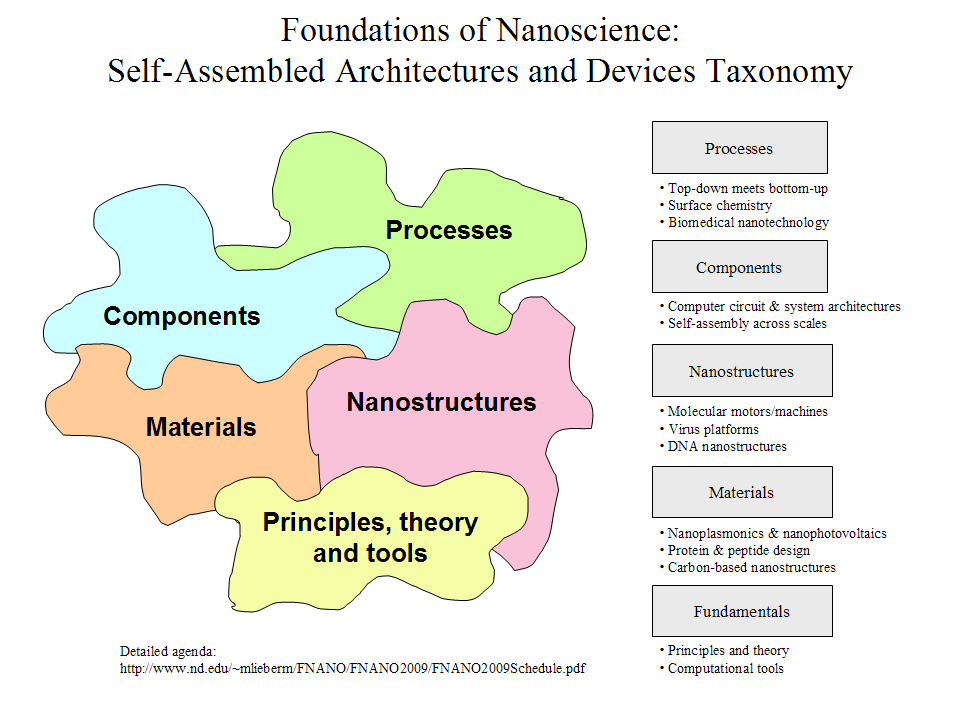
The April 20-24, 2009 Foundations of Nanoscience conference at Snowbird UT provided an interesting look at the wide variety of subfields and applications for nanoscience in thirteen tracks roughly organized into five areas: principles, materials, nanostructures, components and processes (Taxonomy, Quick Reference Guide to Current Research). Many of the nanoscience subfields have been in existence for five to ten years, however the different nanotechnology science and commerical efforts are still fairly isolated (for example, there could be an NNI roadmapping initiative). Nanoscience is largely still at the stage of experimental demos rather than quick advances to commercialization. The diversity of approaches demonstrates creativity and the increasing complexity, refinement and sophistication signals that nanoscience could be moving into a more mature era.

Definition and applications
Nanoscience is the interdisciplinary nexus of several fields including chemistry, physics, electronics, biology and materials - a convergence hub between life and technology, organics and inorganics, biotic and abiotic, top-down engineering and bottom-up nature. Researchers exhibit substrate agnosticism as approaches, techniques, tools and applications may be organic, inorganic or synthetic; the focus is on properties, functionality and requirements.

Nanoscience also encompasses fundamental understandings such as the definition of life, for example, it can be argued that self-replicating crystals constitute organic life. The potential uses of nanoscience are manifold, particularly in electronics, medicine, sensors and materials.

Drug delivery and bridging the gap from end-of-the-roadmap Moore’s Law computing to molecular electronics are the most urgent potential applications.
Figure 1: The End of Moore's Law and the gap between microprocessing and nanoprocessing

The central issue is working with today’s top-down engineered approaches which are specific but limited, to reach the molecular scale, by either extending existing methods or integrating or substituting them with molecular (organic) methods. Biology is a molecular system that works, in fact many interlinked systems. While it is messy to characterize and direct, it has tremendous potential both in its existing mechanisms and novel constructions. However, new materials and processes could be challenging to bring into the existing electronics fabrication value chain.

Status: increasing complexity and working with trade-offs
Broadly, nanoscience is currently in the phase of building on basic configurations to achieve more complex design motifs, for example scaling up circuit arrays from single to double digits, generating 3D construction materials such as 3D nanocrystals, making molecular motors from biological parts, producing active vs. static building blocks and a variety of structurally strong shapes such as icosahedra and other polyhedra. In addition to increasing complexity, another major theme is the sophisticated design trade-offs amongst a variety of parameters such as chirality, charge, planarity, time scale dynamics, thermodynamics, binding, distance, solubility, aggregation, functionalization and materials.

Wonder tools: DNA and CNTs
DNA and CNTs are the most widely used materials in nanoscience. DNA is a tremendously versatile tool not just as an information carrier and material for building structures but also as an external tagging agent on particles and as a template for directing the growth of nanocrystals and metal wires. As has long been realized, carbon nanotubes have many desirable properties for a wide range of applications but still prove elusive to manufacture to spec in large quantities.

Conclusion: moving nanoscience to nanotechnology
Many fields of science now operate at the nano or molecular scale and it is clearly useful to have a foundational characterization and established toolkit for molecular science. One next phase would be moving nanoscience to nanotechnology, seeing a tight linkage between the emerging novel materials, nanostructures and architectures to the engineering and realization of applications.

Sunday, April 26, 2009

Ultimate possibilities for life and technology

Thinking really long term, what would it be like if all matter, including life, could be designed and built to specification with nanotechnology and synthetic biology? Form factor could become ephemeral and purpose-driven. An intelligence could embody as a human, as a fleet of starships, as a crane, as a school of nanoparticles, or remain digital.

Some interesting issues could come up, say from having multiple persistent copies of one intelligence. What would the social, legal, economic etiquette and governing laws be? Or would these words even make sense anymore? The notion of the distinct individual may become obsolete.

Transhumanism will be an interesting and certainly divisive step, when groups or all humans have radically enhanced capabilities as compared with today. Posthumanism, the moment of speciation, may be quite a shock.

What about utility functions? In a digital format, traditional biological functions make a lot less sense. And what about emotion? Is there a relevant adaptation for the digital substrate or is emotion just another biology-based information system?

What is intelligence and is it reflected differently in a digital medium without the sensory input context of the physical world? Maybe intelligence is nothing more than manipulating patterns of information.

Finally, what are the ultimate possibilities for life and technology once joined? What if any would the activity be? Would the focus be on aesthetics? Analytics?

Sunday, March 01, 2009

Foundations of bio-info tech convergence

The most important thing that became clear at last week’s 2nd annual Unither Nanomedical & Telemedical Technology Conference is that many different foundational technologies are starting to be in place for bio-info tech convergence. Ray Kurzweil and others herald the eventual re-engineering of humans into technology that can learn and evolve as fast as infotech but may not realize pathways for bio-info tech convergence are already underway.

Boundaries and definitions of organic and inorganic, natural and synthesized, biological and electronic are blurring into a variety of permutations.

It is almost becoming anachronistic to talk about bio-info convergence when the focus in some fields has already progressed to resolving the problems at hand with the available tools which may include any variety of organic, inorganic and hybrid models.

Three key areas with developments underway:

1. Nanoparticle drug delivery systems
With 5 million people receiving some sort of cancer radiation therapy worldwide each year, and cancer quickly becoming a major killer in developing as well as industrialized countries, improvements in diagnosis and treatment are sought. The nextgen standard could be nanoparticle drug delivery systems (diagnosis is still too challenging of a problem in comparison), which could be used independently or in combination with existing radiation technologies to ameliorate treatment. Many different types of nanoparticles (carbon nanotubes, calcium phosphate, gold and various magnetic nanoparticles) and related technologies such as minimally invasive nanoXrays are under development.

2. Implanted monitors and body area networking
The most obvious case of human-device integration is pacemakers (500,000 are implanted worldwide annually). The latest versions feature one-way broadcast with the devices communicating information externally to physicians for remote monitoring; wireless heart sensors currently have an installed base in the U.S. of over 150,000. Human wireless sensing is further conceptualized as body area networking, which mainly means sensors that are internal or external to the body transmitting data one-way. The IEEE working standard for this communication is 802.15.6. The next steps would be enabling two-way broadcast, bringing some light processing on-board the implanted or external body sensors and later, augmentation. Brain-computer interfaces (BCIs) are developing in lockstep.

3. Powering implants: one idea is the ATP chip
One of the biggest challenges with devices implanted in the body is energy; providing adequate ongoing power to the device. Power trumps the other two concerns: bandwidth and biocompatibility. Many interesting methods of power generation are being investigated including thermal and vibrational energy, RF, light/PV, biochemical energy and the ATP chip, possibly getting nanodevices to produce ATP from naturally circulating glucose.

Apparently no one is yet considering the human bacterial biome as a therapeutic or augmentation platform but this could be another interesting means of bio-info tech convergence.