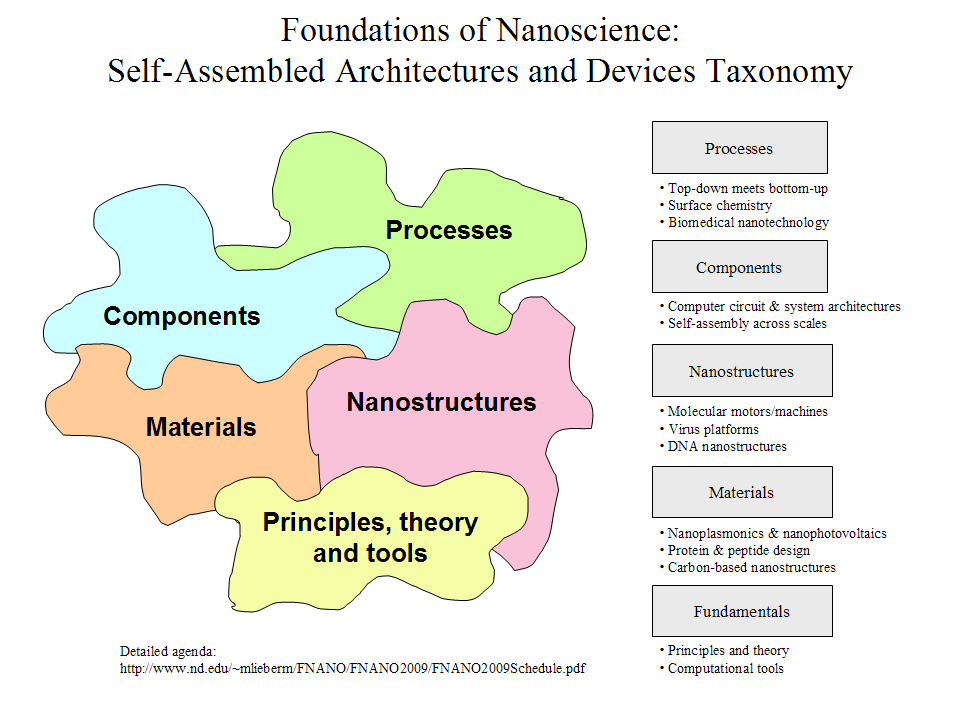
The April 20-24, 2009 Foundations of Nanoscience conference at Snowbird UT provided an interesting look at the wide variety of subfields and applications for nanoscience in thirteen tracks roughly organized into five areas: principles, materials, nanostructures, components and processes (Taxonomy, Quick Reference Guide to Current Research). Many of the nanoscience subfields have been in existence for five to ten years, however the different nanotechnology science and commerical efforts are still fairly isolated (for example, there could be an NNI roadmapping initiative). Nanoscience is largely still at the stage of experimental demos rather than quick advances to commercialization. The diversity of approaches demonstrates creativity and the increasing complexity, refinement and sophistication signals that nanoscience could be moving into a more mature era.
Definition and applications
Nanoscience is the interdisciplinary nexus of several fields including chemistry, physics, electronics, biology and materials - a convergence hub between life and technology, organics and inorganics, biotic and abiotic, top-down engineering and bottom-up nature. Researchers exhibit substrate agnosticism as approaches, techniques, tools and applications may be organic, inorganic or synthetic; the focus is on properties, functionality and requirements.
Nanoscience also encompasses fundamental understandings such as the definition of life, for example, it can be argued that self-replicating crystals constitute organic life. The potential uses of nanoscience are manifold, particularly in electronics, medicine, sensors and materials.
Drug delivery and bridging the gap from end-of-the-roadmap Moore’s Law computing to molecular electronics are the most urgent potential applications.

The central issue is working with today’s top-down engineered approaches which are specific but limited, to reach the molecular scale, by either extending existing methods or integrating or substituting them with molecular (organic) methods. Biology is a molecular system that works, in fact many interlinked systems. While it is messy to characterize and direct, it has tremendous potential both in its existing mechanisms and novel constructions. However, new materials and processes could be challenging to bring into the existing electronics fabrication value chain.
Status: increasing complexity and working with trade-offs
Broadly, nanoscience is currently in the phase of building on basic configurations to achieve more complex design motifs, for example scaling up circuit arrays from single to double digits, generating 3D construction materials such as 3D nanocrystals, making molecular motors from biological parts, producing active vs. static building blocks and a variety of structurally strong shapes such as icosahedra and other polyhedra. In addition to increasing complexity, another major theme is the sophisticated design trade-offs amongst a variety of parameters such as chirality, charge, planarity, time scale dynamics, thermodynamics, binding, distance, solubility, aggregation, functionalization and materials.
Wonder tools: DNA and CNTs
DNA and CNTs are the most widely used materials in nanoscience. DNA is a tremendously versatile tool not just as an information carrier and material for building structures but also as an external tagging agent on particles and as a template for directing the growth of nanocrystals and metal wires. As has long been realized, carbon nanotubes have many desirable properties for a wide range of applications but still prove elusive to manufacture to spec in large quantities.
Conclusion: moving nanoscience to nanotechnology
Many fields of science now operate at the nano or molecular scale and it is clearly useful to have a foundational characterization and established toolkit for molecular science. One next phase would be moving nanoscience to nanotechnology, seeing a tight linkage between the emerging novel materials, nanostructures and architectures to the engineering and realization of applications.


 Email me
 Twitter
 Subscribe to blog
 MS Futures Group
 Data Visualization Wiki
 Economic Fallacies