Monday, May 24, 2010

Human-data interface

There is starting to be more data than ever available to individuals, including personal data, every detail of interactions, activities, behaviors, and health habits tracked. Some contend that humans are not ready to interact with massive data and that a common response is to ignore it. However, humans quickly adapt to most situations and this is the likely course with big data interaction.

Data is likely to only become more pervasive and intimate, and extraordinarily useful to those who can harness it.

There is a structural factor with data collection that could be masking the value of the information – timeframes and scale. Data is collected on daily or hourly timeframes, but may be most useful 1) being dormant, a reserve reference with which to compare when anomalies arise, and 2) longitudinally, reflecting attributes over long time scales; seeing a change in sleep patterns over decades for example. Another example is that while it might seem useless to record one's temperature every day, knowing the average temperatures and heart rates of individuals in a community and any deltas (changes) could be quite useful in predicting the spread and magnitude of pandemics such as H1N1.

Sunday, May 16, 2010

Unified health data climate

The future of health management and biosecurity is having always-on access to the health data climate of individuals, families, communities, and countries. A whole new era of health awareness and self-management could be possible. Ideally, health data streams would be automatically captured and parsed into a comprehensive tableau of status monitoring and action-taking.

Key health data streams (Figure 1):

  1. Genome - whole human genome sequence, abnormal tissue sequences (cancer, etc.)
  2. Phenotype - current status of a wide range of biophysical markers including blood-based organ-secreted proteins prognosticating disease, cholesterol levels, blood pressure, and emotional state
  3. Diseasome - catalog of cumulative immune system exposures and predicted response to toxins
  4. Microbiome - microflora bacteria profile (gut, genital, skin, oral, etc.)
  5. Environmentome - external environment measures including air and water quality, pollen/allergens count

Figure 1: Key health data streams.

Sunday, May 09, 2010

The big data graph era

With the start of the big data era and the ability to collect, store and render meaningful numerous data points, the cultural outlook of the world is shifting too. Graphs, graphs, graphs. Individuals and communities have a social graph, taste graph, preference graph, affinity graph, attention graph, intention graph, values graph, emotion graph, health graph and more.

Graphing theory is being applied to many new contexts such as social networks, media consumption, nanotechnology fabrication, gaming, and genomic analysis and could be one of the many data analysis techniques applied to any large dataset. VLDS – very large datasets – and moving back into the cloud mean that sophisticated data analysis and artificial intelligence techniques could be an expected feature of websites just like social networking commentary and gaming elements have become today.

Sunday, May 02, 2010

The preference economy

There is now the new era of a multicurrency society. Numerous non-monetary currencies are coveted, amassed and exchanged including reputation, social graph, time, ideas, intention, attention, affinity, preference, health, and resource access.

The internet is already doing a good job of serving as a clearing exchange and means of valuation for the currencies of reputation, social graph, intention, and attention.

The next generation of economy 3.0 startups is building even more dimensionality into the multicurrency society.

Blippy broadcasts purchasing activity and serves as a leading indicator for public company quarterly sales; a real-time economy feed.
Hunch goes a step further with the grand vision of mapping and predicting the affinity of all people for all objects.
For example, what is any individual’s preference for Nike, TikTok, Slaughterhouse-Five, Ulan Bator, existentialism, or any other noun, brand, product, item, object or idea. Social feed “likes” are already being mined for preference, affinity, and revenue.

Value, preference, and affinity could become an expected attribute of any product, brand, website, and experience just like social networking is and gaming principles are starting to be. These seemingly unobtrusive currencies could stream nicely into exchange via automatic markets.

Sunday, April 25, 2010

Supercomputing and human intelligence

As of November 2009, the world’s fastest supercomputer was the Cray Jaguar located at the U.S. Department of Energy’s Oak Ridge National Laboratory, operating at 1.8 petaflops (1.8 x 10¹⁵ flops). Unlike human brain capacity, supercomputing capacity has been growing exponentially. In June 2005, the world’s fastest supercomputer was the IBM Blue Gene/L at Los Alamos National Laboratory, running at 0.1 petaflops. In less than five years, the Jaguar represents an order of magnitude increase, the latest culmination of capacity doublings each few years. (Figure 1)

Figure 1. Growth in supercomputer power
Source: Ray Kurzweil with modifications

The next supercomputing node, one more order of magnitude, at 1016 flops, is expected in 2011 with the Pleiades, Blue Waters, or Japanese RIKEN systems. 1016 flops would possibly allow the functional simulation of the human brain.

Clearly, there are many critical differences between the human brain and supercomputers. Supercomputers tend to be modular in architecture and address specific problems as opposed to having the general problem solving capabilities of the human brain. Having equal to or greater than human-level raw computing power in a machine does not necessarily confer the ability to compute as a human. Some estimates of the raw computational power of the human brain range between 1013 and 1016 operations per second. This would indicate that
supercomputing power is already on the order of estimated human brain capacity, but intelligent or human-simulating machines do not yet exist.
The digital comparison of raw computational capability may not be the right measure for understanding the complexity of the brain. Signal transmission is different in biological systems, with a variety of parameters such as context and continuum determining the quality and quantity of signals.

Sunday, April 18, 2010

Radical transparency

Social networking and Web 2.0 has made it easy to find out about the friends, resume, activities, and interests of the many people who permission-in and broadcast this information.

Financial privacy disappeared for groups of the population as benefits outweighed costs in peer-to-peer lending, real estate, expense management, and purchasing with Prosper, Zillow, Expensr, Mint, and now Blippy.

Health data is the new frontier as people are starting to publicly post their genome files, and perhaps blood test information with the SNPedia, Personal Genome Project, and DIYgenomics. Some people are tweeting their weight, and could possibly do so with their sleep-tracking Z scores and other quantified self tracking activities.

In the farther future, who will be the first to tweet their neural feed? The unexpurgated feed that would be captured directly from the brain, not medicated by language, typing, consciousness, and culture as now. As with other successful technology roll-out paradigms, truth culture is likely to be opt-in, and the competitive advantage could likely be with those who do decide to disclose.

Sunday, April 11, 2010

Health 2.0 business models

Health 2.0 is about re-envisioning every aspect of health and health care. New business models are starting to develop to support this innovation ecology. First, accompanying the new paradigm of community research (peer cohort studies à la Patients Like Me (lithium) and DIYgenomics (MTHFR mutation/Vitamin B-12 deficiency), could be social venture finance, corporate sponsorship from supplement companies and other remedy vendors, crowdsourced finance (i.e.; Kickstarter), and philanthropist contributions. Second, the traditional venture capital model is already being applied to health 2.o startup companies, including through organizations such as the Health 2.0 Accelerator. Third, whole new industries may sprout from the nascent efforts of health advisors and wellness coaches. The health advisor is the analog to the financial advisor or mortgage broker, able to integrate a client's health data streams, needs, and interests with available offerings, across a spectrum of economic models: insurance reimbursable, HSA dollars, and direct out-of-pocket spending.

Sunday, April 04, 2010

Mobile app concept: Disaster Telediagnosis

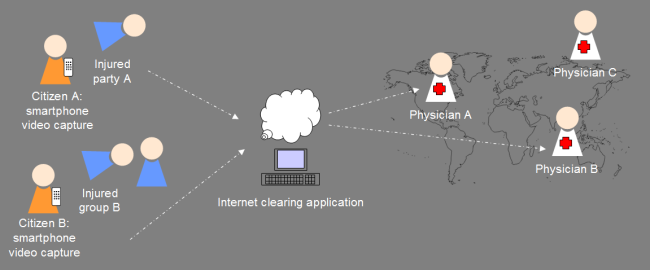
Disaster Telediagnosis is a mobile app idea that takes advantage of the bandwidth and mobility of 4G. It is a massively scalable peer-to-peer clearinghouse application providing live streaming video communication between people injured in a crisis situation and remote physicians for diagnosis and ongoing support until hand-off to local health authorities.

Whenever an injured party needs to interact with a physician, anyone with a smartphone can take a picture or stream live or archived video coverage to the internet clearinghouse to be connected in real-time with any available physician worldwide. There may be multiple interactions between patient and physician, both of whom are mobile, over the course of the case, and continuity can be preserved through high-bandwidth video connectivity. The internet clearinghouse could provide language matching or automated translation, and would log all calls based on GPS and other tagging attributes. Remote physicians could review and annotate patient electronic medical records, and the archived video files would provide patient history.

Figure 1: Disaster Telediagnosis
Any citizen with smartphone video capture could record injured parties describing their conditions, or otherwise document the status of the injured or dead. Video is streamed to the internet clearing application and on to available physicians, possibly with specialized language capabilities.

This application concept is accepted for presentation, if a demo can be realized, at the Clear 4G Symposium at Stanford in Palo Alto, CA, June 15, 2010; any interested developers and collaborators please contact the author.

Sunday, March 28, 2010

Future of Crisis Management

At the CMU-hosted Silicon Valley Crisis Camp, March 26-28, 2010, there was a lively brainstorming session about the longer-term future of disaster management. In the much farther future, crisis response could disappear since disasters might be prevented through weather management, sensor-equipped smartbuildings, and floating movable cities. When disasters do occur, they could be regarded as an annoyance rather than a catastrophic loss of human lives and property through the 3-D printing of physical bodies imprinted with recent mindfile backups, and robot-aided damage clearing and structure rebuilding.

In the medium term, advanced technology could transform crisis response in several ways:

  • Robotic first responders: Autonomous or remote-piloted robots could be used as a substitute to humans for assessing damage, scouting terrain, finding victims, and providing aid.
  • Super-smartphone: Super-smartphones could be messaged or would automatically sense disaster occurrence and switch into crisis mode, making disaster applications easily accessible, for example mapping software layers indicating relief shelters, and automatic status updates from personal social networks. Smartphones could track health status, vital signs, psychological state, and be used for telediagnosis and even possibly DIY surgery or other medical treatment. The user could run a virtual world app on the smartphone integrated with augmented reality to send their avatar out to inspect the local environment for self-rescue and peer-rescue.
  • Building codes 3.0: smart sensors could capture a variety of data about a building’s status and its occupants, for example knowing who or at least how many people are inside a building at any time (with regular data purges to protect privacy).
  • Gaming: An augmented reality (AR) game immediately begins when a crisis occurs. Participants earn points for crowdsourcing/reporting information, uploading video footage documenting damage, and accepting challenges (disaster management-related tasks). There could be many layers to the AR interface, heatmaps showing the injured and dead, building damage, resource availability, shelters and health clinic locations. Gaming could be used to pass time, distract, improve psychological state, and connect those in physical proximity.
  • Market principals: Technology tools could be used to create markets, to facilitate the discovery and exchange of different types of supply and demand: information, labor, time, relief resource availability, and distribution.
  • 3-D printing of relief materials: blankets, food, shelter, medical supplies, and clinics could be printed with 3-D printers and online sharable CAD designs in urgent disaster response. Over time, smart infrastructure printing could be used to reconstruct buildings. Rubble could be recycled into building materials.
  • RFID-tagged resources: all aid resources and donations could be RFID-tagged for inventory management and delivery, including real-time updates of what is still available and functional from local stores; markets could develop to allocate resources.
  • Personal biosensors and bioactuators: personal biosensors are seamlessly incorporated into clothing to provide a personal data climate including both biophysical and environmental data. Biosensors can identify an approaching bioplague, download antibody plans from the internet, manufacture, and administer them. Similarly, radiation-resistant genes found in extremophiles could be downloaded and applied in the case of nuclear incidents.
Reblog this post [with Zemanta]

Sunday, March 21, 2010

Semiconductor roadmap updates

The working group documents and presentations are now available from the most recent International Technology Roadmap for Semiconductors (ITRS) 2009 Winter Conference held December 16, 2009 in Hsinchu City, Taiwan.

One of the most important updates from the ITRS 2009 meeting is a shift out in the time scale for the next expected computing nodes. There is a focus on both FLASH memory ½ pitches and the usual DRAM ½ pitches as smaller nodes are expected to be achieved with FLASH before DRAM. Specifically for FLASH, 22 nm is estimated for 2013, 16 nm in 2016 and 11 nm in 2019. For DRAM, 32 nm is estimated for 2013, 22 nm in 2016, and 16 nm in 2019.

An important architectural shift is underway for packing more transistors onto chips: moving from planar to multidimensional architectures. Another big industry focus is in implementing 450 mm wafers for chip manufacturing, up from the 300 mm current standard. (Figure 1)

Figure 1: One of the world's first 450 mm wafers

In lithography, a key bottleneck area, the two main technologies that will probably be in use for the current and next few nodes are Extreme Ultraviolet Lithography (EUV) and 193 nm immersion half pitch Double Patterning. EUV is less expensive. For later nodes (22 nm, 16 nm, and 11 nm), EUV and double patterning, together with ML2 (maskless lithography), imprinting, directed self-assembly, and interference lithography may be used.

An important challenge is the top-down (traditional engineered electronics) meets bottom-up (evolved molecular electronics) issue of how nodes 15 nm and smaller will be designed given quantum mechanics. The Emerging Research Devices (ERD) and Emerging Research Materials (ERM) working groups presented some innovative solutions, however the majority of the roadmap focus is on the nearer term, the next couple of nodes.