The world is changing. It has always been the case in TechLand but never before has there been so much mobility and opportunity for impact and name-making.
New CyberCelebs emerge every day largely by dint of being there first, by being early users of a new medium or area or product and as things are moving so fast, finding themselves de facto experts whose opinions are sought. CyberCelebs are most often not formally educated in the underlying aspects of their substrates (e.g.; psychology, art, composition, game design, economics, politics, etc.) or sometimes even at all.
Some notable CyberCelebs include Julian Dibbell (gaming economies), Jerry Paffendorf (metaverse worlds) and Robert Scoble (blogging).
That the new experts are not those schooled in underlying principles, but early experiencers of the milieus suggests that:
1) there is tremendous opportunity for anyone to have impact in world-shaping and making a name for his/herself
2) formal education can but slip farther behind in preparing anyone for the world of accelerating technological change. Unfortunately something seems to be missing from both sides, traditional education is anachronistic and irrelevant, and TechLand misses by being homogeneous and narrowly focused.
The best way to be a participatory citizen of today is to splice a self-study program of traditional education with learning new areas though direct experience and blogs.
Monday, August 28, 2006
Les Nouveaux CyberCelebs
Tuesday, August 22, 2006
Personalized Virtual World Views
 Metaverses (metaversi?) are proliferating, from Project Entropia to ActiveWorlds to Blaxxun's 15 communities to There to Sims Online to Second Life (whose residents have more than quintupled since the beginning of the year, especially since credit card identify (and age) verification is no longer required as of June 30).
MyWorld
However, these early metaverse worlds carry in too many incongruous metaphors from the physical world. One is not making use of VR to change the concept and physical layout of space. It should be possible for users to personalize by choosing a profile for the sims (properties/mini-sites) that will display in their virtual world views, at minimum with ad-blocking. The Berners-Lee Internet, in 2d or 3d, is about pull not push; users should have the right to populate their own attention flow streams.
With teleportation being the navigation method of choice, there is no requirement (or detriment to virtual real estate markets and traffic) that sims/locations be contiguous or in any static formation. People visit locations they prefer in virtual worlds anyway, personalized views is merely a facilitation tool that could also lead to greater creativity in developing and using the metaverse world medium.
In addition, personalized virtual world views could help with the zoning, local government, and enforcement growing pains that were expressed at last weekend's second annual Second Life Community Convention.
Imagine logging in to a virtual world and finding sims in your interest profile grouped all around you (possibly above and below as well), showing in different light tints or colors per parameters; a new and growing VR smorgasbord with each visit. View preferences could be changed at any time and could be set to "all" or "random" or even the meta metaverse channel.
As with cell phones, multiple environment profiles (with customized avatars) could be stored for easy access to professional collaboration, education, information gathering, hobby #1, hobby #2, sexchat, etc. Multiple full or partial avatars with simultaneous existence can hopefully be realized soon.
Thinking ahead to business and military applications, flexible user profiles would also allow different hierarchical (meta) tiers and permissioned views of virtual sites/information. There are many ways the property of spatial flexibility can be used to improve and extend the use and value of metaverse worlds.
Monday, August 14, 2006
Making money in video games - ethical?
 Is it ethical to make money in online video games? That is by spending video game time earning gold pieces or other game valuables and currency through patient monster slaughtering and skill/trade acquisition (skinning slain beasts for pelts). The gold can later be converted to physical world currencies at game trading sites like MarkeeDragon or eBay or by trading with other players.
Anachronistic economic imperative persists
Despite general resource abundance and continually increasing efficiency of matter usage, there is a diminished but still present economic imperative in the physical world; it is necessary to earn or have some degree of money to provide for survival needs. Given the economic imperative, the rational being will find the most expedient means of meeting this requirement and would certainly consider video game income generation as an option. If one can make the same or more money in less time in a video game, why not do it! And many are, from MMORPG gamers to Second Life metaverse merchants.
Is video game playing a potential career?
Some might dismiss video gaming for income as a dull routine of repetitive tasks, hmm...which sounds exactly like...most physical world jobs. Gaming has many benefits including allowing one to set one's own hours, providing a clear means of status and progression up the hierarchy and the ability to choose the degree of partnership with others. Again, why not cover expense demands via gaming and pursue other projects and interests with the rest of the time saved by not having a regular job.
Parasites?
By parallel, stock market traders have been denounced as parasitical for not making real and tangible products but living derivatively from the efforts of others. In reality, investors provide liquidity and take risk, without which financial markets would not exist. Video game income earners are the same; they could also be accused of being parasitical but in reality are providing the liquidity which makes virtual markets work and in addition are facilitating the transition and advancement of humans and intelligence to the machine substrate.
A large class of humans is growing that is comfortable with a variety of physical world and virtual world activities for a wide variety of purposes ranging from social to creative to income generating. Video gaming skills and knowledge often translate back to physical world activities too, who doesn't list their WoW Lvl 60 Mage 200 person raid-leading skills on their resume?
There is the usual tired argument that what if everyone wanted to make money in video games, who would make the "real" physical world stuff? Well, not everyone has become financial traders, so presumably not everyone would seek to earn their only income in video games, also with the likely increases in robotics and molecular manufacturing revolutions in materials, the world of stuff will continue to occupy fewer and fewer people.
Future of Transactions: Virtual Affinity Groups
There are already many virtual markets, including financial, prediction, eBay, P2P lending, MMORPG and metaverse worlds to name a few, and the type and nature of virtual markets will continue to grow. The Internet is awash with social liquidity that will likely be directed into Virtual Affinity Groups that self-assemble for the purpose of economic, political, etc. transactions.
Tuesday, August 08, 2006
Five years to Chinese economic domination
 Applying the CIA Factbook's 2005 growth rates to GDP numbers and extending for several years suggests that China's GDP will have surpassed that of the US by 2011 (in less than five years) when both countries will have GDPs of about $15 trillion. Of course it is expected that China's torrid 9.9% growth rate will slow, and China may be more prone to reporting errors but the trend to economic dominance role reversal is clear.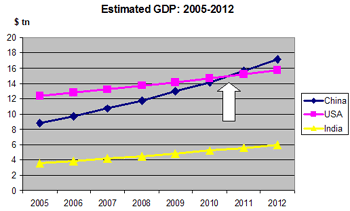
In 2005, the US had a GDP of $12.4 trillion and a growth rate of 3.5% and China had a GDP of $8.9 trillion and a growth rate of 9.9%. Developing world peer India starts with a lower base ($3.6 trillion in 2005) and has a healthy 7.6% growth rate, but is not forecast to catch up to the US and China in the next decade, if linear growth persists.
Interestingly, the arena for China's growth is not limited to the traditional, physical world of GDP; the more important Chinese economic dominance may be in digital worlds. Merely the opening act features China as already a huge participant in the digital economies of metaverse worlds like Second Life and Internet gaming by manning and sometimes creating and improving bots to mine gold and other MMORPG video game valuables.
Friday, August 04, 2006
The Future of Writing: Blog extensibility
 Software and web applications - wikis, blogs, photo-sharing, bookmarking, tagging and open content management platforms like drupal have revolutionized Internet communication. These new applications create an alive and interactive web as they allow commenting, profiles, links, rating and editing. This transformational wave is still accelerating, but it is clear that how we conceptualize and engage in communication and content creation in all contexts of our lives is being reshaped.
This alive and interactive web has two principal benefits: serving as a self-expression mechanism (see "The Real Killer App: Personal Expression") and socialization facilitator and, more importantly, leading to better content. Some comments are like cocktail conversation, language niceties, essentially another human analog to the communal grooming of apes. Some comments extend the conversation which creates more information. Tags, links, comments and trackbacks build an information-plex much greater than the views of one person around the original post and more information (less entropy) is always desirable as astrophysicists attest. Content is better and creates more information because it is alive and interactive.
Blog Books
Now there is a trend to take online content back to traditional print content. Lulu and Blurb are publishing platforms where blogs or any other content can be uploaded (free) and printed as a book (charges vary). Which points up the question, what is the role of books and other traditional print media in this new era of increasingly alive, interactive, connected content? Circulations for newspapers and magazines have plummeted; what is the future of books?
Essence of Blogposts
Blogging is quite a new form of expression. The essence of a blogpost is often drawing attention to one or many ideas, happenings or news items and then commenting on them or deriving additional analysis and ideas from them. Even personal narrative posts are likely to draw in outside ideas, technologies and influences. A blogpost can be much denser and less linear than a page of text from a book.
What is reading a Blog Book like?
Blogs as a distinct form of writing leads to the blog as a book being an interesting concept. Unsurprisingly, reading a book of blogposts is different than reading a regular book. Blogposts are dense, non-linear, discrete entries complete unto themselves. The reader must create the connection between posts in the absence of flow across pages the way a fictional story or non-fictional argument slowly builds and develops. The reader performs the higher cognition of connecting themes and meta-messages from the blogposts.
Blog extensibility tools
A useful tool, an extension of Lulu and Blurb, which I thought both were at first, would be to take the text in a blog and pull it into one cohesive whole. From the body of disparate blogposts over time, themes, progressions in thinking and multi-dimensionality arise which could be further developed via a tool organizing a blog (by tags, categories, keywords, etc.) into the basis for chapters which the author could develop into a more complex analysis and comprehensive work such as a traditional essay or book.
Making books more alive
In addition to tools for aggregating blogs into more comprehensive wholes like books, making books more like blogs would also be useful. After blogging, writing in MS Word, etc. is hopelessly old world - linear, static and non-interactive. Tools are also needed for re-creating the traditional essay or book format in the non-linear, interactive, connected style of less formal web writing. This could be achieved easily by adding functionality to blogging software.
Information is Alive!
Imagine a future where all information is alive, interactive and linked: books, essays, academic papers, blogs, vlogs, photos, videos, music, email, etc. As the world's information is increasingly digitized and available and searchable in a single or linked repository, there will be more tools for knitting different formats of content on the same topics together. BlogSearches and regular searches will probably not be disjoint for much longer and will start to incorporate more media types. It would be great to have a universal information file with user-set parameters that continuously updates and auto-searches, auto-organizes and auto-summarizes all available information (from academic papers, books, press articles, blogs, etc.) on selected topics and could be viewed online, downloaded to an electronic or print book or directly into the brain.
Wednesday, August 02, 2006
Latest evolutionary meme: MommieBlogger Angst
 The concept and act of parenting has changed dramatically in the last generation, thus far mainly in America, with many parents now viewing their roles as entertainers, body guards and support staff. These parents have clearly not read Judith Rich Harris’ defining work The Nurture Assumption which notes that quality of peer group, not parental behavior, is the key determinant of success and happiness for children (and adults).
The interesting question is what impact, if any, this shift in parenting will have on the psychology and reproductive trends of the next generation (assuming the singularity doesn’t arrive first). Will millennial children of boomer Parents 2.0 have more or less biological children themselves? If fewer, it would be another victory for memes over genes as Richard Dawkins in the Selfish Gene, Susan Blackmore in the Meme Machine and Keith Stanovich in Robot’s Rebellion purport.
Culture and cultural memes are highly effective at evolving, morphing nearly immediately in minutes, days and years as compared with biological evolution which, currently unaided, takes at minimum about 10,000 years.
Culture has created another first world disease, MommieBlogger Angst, essentially (per the MommieBloggers) a rebellion against the rigors of child bearing and child rearing (such unforeseen surprises!), but which is really an encouraging response from women striking out about how highly under-actualized they are. MommieBlogger Angst received big dialogue amongst the parenting set at July’s 2006 BlogHer conference in San Jose, California. By the way, where are the DaddyBloggers?
Luckily, there is an easy solution at hand for MommieBlogger Angst for those willing to apply critical thinking to social hypnosis; forego the kiddies and be part of the growing childfree movement. Nothing would impel women’s equality faster than refusing to have children. However, ironically, MommieBlogger Angst is more than just a reflection of the isolation and criticism mothers feel, it is actually (social science PhD topic seekers take note) indicative of a much more important trend, that of women demanding to use their brains, and voice their thoughts at not being fulfilled in the mother-only roles they think they chose for themselves.
Friday, July 28, 2006
Will Artificial General Intelligence do art?
 Webster defines art as "the conscious use of skill and creative imagination especially in the production of aesthetic objects." The first part of the statement seems to hold for AGI, it is likely, almost by definition, that AGI will have consciousness (e.g.; self-awareness), skills and imagination.
In the extended clause, the term objects is also fine, as objects can exist in the physical world or in digital worlds, do not need to be continuously instantiated and do not need to be instantiated at all to be accorded value by AGI. Aesthetic is the most problematic aspect from AGI's view point as aesthetics could be driven rationally, as in by geometric proportions, or emotionally, as in by feelings. AGI will have rationality but maybe not emotion. Emotion is not likely a precondition for intelligence.
How do humans know something is beautiful? It is a subjective judgment, but so can it be subjective (individual, heterogeneous) for AGI. Humans may claim the process of evaluating beauty is subjective too, but it is likely that the process is routine; sensory information comes into the brain and properties (symmetry, color, melody, etc.) are identified and processed, some of which may elicit emotion. Emotion is possibly an after-the-fact signal for more expedient cortical interpretation but not required for perceiving beauty.
Progressing from this simple analysis that AGI could have the concepts of art and aesthetics, how relevant will this be to its priorities? "The conscious use of skill and creative imagination" will likely be the chief activity of AGI, but not for creating stuff, rather for creating ideas, hypotheses and experiments with aesthetics being defined as simplicity, accuracy and economy of solution. AGI art is scientific discovery.
Using machine intelligence for knowledge generation
 What will artificial general intelligence (AGI) do with its infinite time and initially great computational resources? Like humans, AGI will be goal directed, though likely in a more focused way, so AGI would be likely to do the same things as humans but in different ways (e.g.; using parallel, distributed, etc. methods) and with different proportions; these activities are:
1) Control matter
2) Solve problems and fulfill needs
3) Create/discover new knowledge
The difference is that AGI will nearly exclusively spend its time in #3 vs. most humans which do the opposite.
Once securing survivability, AGI will need to spend a minimum of time controlling matter. AGI will also need to spend a minimum of time fulfilling needs as biological needs are eradicated and emotional needs are also likely expunged having been translated into goal motivators.
AGI will be concerned with what any next evolution of intelligence would focus on; solving outstanding problems, being creative, discovering anything not previously known or understood such as a grand unifying theory of physics, faster than light travel, the riddles of dark energy and dark matter and controlling the force of gravity.
Given the benefit of dramatically extending knowledge in these ways and the challenges and long road to AGI, more purpose-specific machine intelligences (narrow AIs) should be build to concentrate on singular problems.
Wednesday, July 26, 2006
Enterprise software-as-service kinks
 Marc Benioff's proclamation at the AlwaysOn Innovation Summit at Stanford today that the "Business Web is Here" seems a bit unfounded given a) that its not, b) Salesforce.com's legendary outages, c) the company's 50% drop in stock price so this year (vs. a 15% drop in the NASDAQ) and d) a similarly lackluster showing from software-as-service peers RightNow Technologies, NetSuite and others.
Meanwhile, Oracle's market value has quietly doubled in the last four years as the company has had to provide support for the whole market of enterprise software solutions. 94% of Oracle help desk calls involve integration with other applications. Oracle customers' number one business process challenge is other applications: conflicting instances of invoices, databases, etc. on multiple systems.
The challenge for both established (former darling SAP's recent downside earnings surprise, for example) and startup enterprise software companies remains unseating Oracle which is a formidable obstacle for many reasons including the still problematic software-as-service model. Open source and Web 2.0 solutions are distant alternatives given their current lack of scale, reliability, maturity and implementability for reaching serious CIO consideration. Unfortunately, enterprise software continues to be driven by CEO ego wars as opposed to an innovative look at customer needs.
Tuesday, July 18, 2006
The myriad flavors of spaceflight
 The best Earth views can be had for $20 million (plus $15 million for a space walk) which is actually getting cheaper since Russia has not changed the price in the five years that they have been offering space tourist visits to the International Space Station. So far, there have been three paying space tourists and more are scheduled including X Prize donor Anousheh Ansari. The rigorous medical examination and training for orbital flight is detailed here.
If one can be content with suborbital flight and waiting a few years, there are more options, the cost is dramatically cheaper and the six month cosmonaut training is obviated. There are many potential providers of suborbital flight, including Space Adventures (2007-2008 timeframe), Incredible Adventures aboard the Rocketplane, and Virgin Galactic via Spaceship Company ships to be built by Burt Rutan's Scaled Composites. The Virgin Galactic suborbital flights are $20,000 and are due to depart later this decade from a $200 million spaceport to be created in New Mexico.
Zero gravity flights are available right now from a variety of service providers including Space Adventures, Incredible Adventures and X Prize Foundation founder Peter Diamandis' Zero Gravity Corporation, who flies 15 parabola rides for $3750 out of Florida, San Diego and San Jose.
It's great that so many people, both astronauts and cosmonauts (400 to date) and private citizens are having an opportunity for space-related experiences. Hopefully this increasing activity will continue to raise interest, support and involvement in space, astronomy and science in general.


 Email me
 Twitter
 Subscribe to blog
 MS Futures Group
 Data Visualization Wiki
 Economic Fallacies