 The whole point of AGI is its broad flexibility to have many formats both resembling and greatly extending human-level intelligence.
An unfortunate artifact of the human substrate is that so much processing is devoted to the sensory network input and output and other demands of having a body and so little is available for the higher levels of intellectual processing and knowledge extension.
The computer substrate is of tremendous benefit to AGI. Not only does the AGI not have the physical, sensory and processing constraints of a body, neither does it have the time frame constraints of biology; it can evolve at exponential rates that would never be possible in biological substrates. Further, the human sense of identity and consciousness is body-grounded, awareness and control only extends to the barriers of the human body. In a computer network, the domain and locus of control is potentially as broad as the network and can be fluid and changing and distinct by function. This broad and malleable perception and control domain may lead to the development of quite different consciousnesses than human consciousness.
Even the term 'embodiment' is anthropomorphic in that it means a form that can be seen by humans, particularly a human-type form as in a robot; AGIs can theoretically take on many or multiple embodiments but in their highest form do not need any.
Some argue that embodiment is necessary to produce and evolve AGIs and certainly this is one approach, at this early stage of AGI development, all approaches should be tried, including other non-embodiment models.
Wednesday, May 31, 2006
Non-embodied AGI is preferable
Sunday, May 21, 2006
Seminal Singularity and AGI events
 Two recent events, the Singularity Summit on May 13, 2006 at Stanford University in Palo Alto, CA and the Artificial General Intelligence Research Institute's Workshop on May 20-21, 2006 in North Bethesda, MD featured many of the key people known to be involved with the singularity and artificial general intelligence (AGI) movements respectively in side-by-side presentations and were seminal in crystallizing the progress to date in these areas and the dramatic degree of future progress required. Two of the key challenges appear to be:
1. the siloed thoughts of individuals for the most part completely without collaboration and not sharing a common nomenclature (particularly in the singularity area), and
2. the theoretician's anti-action bias
After decades, it is still the early days where theory not action dominates which suggests that collaborative, open-source models could be most productive for reaching goals. Ongoing focus workshops could help formalize the singularity and AGI movements, attract funding and facilitate collaboration or at minimum discussion of key problems. A technology roadmap could be a key tool developed at these meetings, the meetings being like IEEE technical committees having regular schedules and targeted problem areas, and could help overcome the reticence of theorists, academic and otherwise, to take action in service of achieving singularity/AGI objectives.
In the singularity area, a marketing, outreach and policy organization, perhaps somewhat similar to nanotech's Foresight Institute, could help the movement articulate an agenda and popularize the ideas and offer ways for people to get educated and involved. Seen from a business lens, some simple steps could be taken to move the singularity movement to a broader audience: injecting marketing (e.g.; for starters, identifying the agenda and who is the audience, what is the message and how to position the message to the audience) and facilitating the above-mentioned workshops to demolish ego-heavy siloes and anti-action bias.
Wednesday, May 17, 2006
Hybrid learning models needed
 Continuous education is imperative with the current rate of changing technology to allow one to fully participate in the world of today and the future. Academic models seem outdated and ill-suited to provide the relevant learning to bridge the gap to brain-loaded SkillPaks and KnowledgePaks for many reasons including that academia has not been forced to innovate and adapt, particularly to technological changes, as have other disciplines such as business, law and medicine.
There is a need for hybrid learning models which incorporate the attributes formerly possessed by academia: expertise, thought leadership and comprehensive curricula development and delivery with results and accountability, and the creativity, innovation and sense of what is important attributes of individually-directed pursuits merged with the real needs of the work and project space.
Online courses and even undergraduate universities have high percentages of student drop-outs, so the new hybrid learning models must create implicit incentives for participants to continue their learning, one way to instill accountability would be by creating small learning communities.
An increasing number of people have the time and resources to pursue areas of interest to themselves, both theoretical and applied, and there is a tremendous opportunity to develop learning mechanisms which provide a structured way to learn about a topic comprehensively and validate that knowledge. As a P.A. (Physician's Assistant) is the perfect merger between the required capabilities of a doctor and nurse, there should be some hybrid acknowledged "degree" or other validation of a significant program of study in between a Ph.D. and a continuing education course.
Sunday, May 14, 2006
Space elevator quickens reach to Mars
 An area of technological advance with some exciting recent results is the space elevator industry. As the X Prize ignited interest in commercial space travel and the jet taxi industry is taking off, the Spaceward Foundation is inciting development of the space elevator and several organizations, including the LiftPort Group, are starting to show some promising results.
As prizes are now de rigueur for competitive technology development (X Prize, Methuselah Mouse Prize, DARPA Grand Challenge, etc.), the Spaceward Foundation has been extending the space elevator development in conjunction with NASA with the Centennial Challenges. In 2005, teams designed climbers to mount a 200 foot tether powered by laser. In the fall of 2006, at the X Prize Games in New Mexico, space elevator innovators will be competing in new tether design (which has a multiplicity of terrestrial civil engineering applications) as well.
The space elevator concept became technically feasible with the advent of carbon nanotubes as a material for tethers that will not snap under it's own weight. Space elevators could replace or supplement space shuttle and other rocket launch of satellites, missions and materials into space at a fraction of the cost. The current estimated cost is $10 billion to put the 62,000 mile long ribbon and 1500 ton space elevator fully in place; this translates to the bargain price of $2-$3 per ton to lift cargo into space.
In addition to improving existing applications, the space elevator can engender a host of new applications such as allowing the raising and positioning of solar energy collectors that beam the energy back to Earth (a concept initially suggested by Gerard O'Neill). Perhaps one of the most interesting and impactful new developments could be the Mars Express; once orbital, once a day, loads could be pushed off in a trajectory towards Mars. A similar space elevator on Mars (working offside the equatorial moon Phobos), could launch daily loads Earthward.
Saturday, April 29, 2006
Virtual Affinity Group power
 P2P loan marketplace sites Prosper and Zopa may not even realize the tremendous extensibility of the platforms they are creating. Prosper has created a group lending structure as microcredit and affinity models have shown that repayment ratios should be higher for group members than standalone individuals due to the community shame factor, incentives and (in the Grameen Bank model) cross co-signing of the loans.
Two months after the site's public launch, Prosper members have started over 1200 affinity groups, in a full breadth of areas ranging from entrepreneurs to libertarians to military and religious groups to LGBTs to college alumni to gardeners, essentially in any personal, professional, educational, religious, hobby, etc. affiliation that a person may have.
These Virtual Affinity Groups will start to amass tremendous economic power, bringing hundreds of individuals together both on an ongoing basis and as virtual "flash mobs" for the purpose of participating in specific transactions or other activities.
Virtual Affinity Groups may get their start in the lending context but can quickly expand to include all community financial transactions: GroupCredit, GroupInvesting (real estate, etc.), GroupPurchasing, GroupJobs/GroupProjects and GroupPhilanthropy/GroupSocial Entrepreneuring. Financial transactions no longer need to be unitary, all major financial transactions can take place in groups, with radically different business models, on an unprecedented scale and with tremendous savings and efficiency, for example, GroupPurchasing can include vendors bidding to groups of thousands of buyers assembled to purchase certain items and services.
Beyond the economic sphere, Virtual Affinity Groups can also wield substantial political and social power, for example with purpose-based assembly and disassembly of affinity PACs, and regular voting on general issues, say each registered voter has a high-level ballot of daily or weekly state and federal legislature issues on which to have general input.
The ability to collect thousands of individuals around a temporary or ongoing purpose on the Internet is possibly the most important and interesting functionality of what is being created by P2P lending marketplace platforms.
Wednesday, April 26, 2006
Intelligent Machines: tool, not threat
 In "On Intelligence," Jeff Hawkins' focus on Machine Intelligence, a near-term, human-controlled tool as compared with Artificial Intelligence, a longer-term self-evolving entity that could dominate humanity is a nicely-defined accessible area of the near future.
His framing of the Intelligent Machine as a tool for extending human capability liberates the stalled Artificial Intelligence focus on the humanoid, Turing Test-passing form of created intelligence and frees the imagination to consider the possible uses of intelligent machines with non-human properties.
Hawkins affirms the difficulty of envisioning the specific applications of radical new technologies and suggests the technique of identifying the properties and capabilities of future intelligent machines such as speed (electrical pulses traveling a million times faster than neuronal impulses), capacity, breadth, pattern-recognition and sensory systems comprised of all naturally existing systems (including radar, sonar, echolocation, electrical field sensing, etc.) plus new senses natural to the digital substrate, and then envisioning uses from these properties.
Intelligent machines can be useful as a tool for extending human knowledge, understanding and predictive capability for phenomena where direct human perception is limited. Just two of these extremely important areas are highlighted here:
-First considering mathematics, physics and biotechnology, intelligent machines can potentially think in more dimensions than three or four, providing tremendous value not only in solving problems but in merely representing string theory, protein-folding and cell process phenomena.
-Second, considering scale, intelligent machines with orders of magnitude of greater depth and breadth of pattern-recognition could possibly model and predict weather, energy consumption, demographic shifts and animal migrations with the same facility that humans use to gauge the crowdedness of the road on the daily commute.
In Hawkins' view, intelligent machines are not threats and not mini-humanoids but very nice tools for increasing human knowledge and capability, a view which can only be lauded.
Sunday, April 16, 2006
Machine intelligence to evolve non-human senses?
 Jeff Hawkins has a recipe for building intelligent machines in his 2005 book, "On Intelligence.” Step one is creating a set of senses that conduct pattern recognition over their environment. Hawkins notes that machines could have new senses, senses that do not just correspond to the five human senses.
Certainly machines can be better at receiving sight and sound input (electromagnetic spectrum pulses and sound waves), discerning a wider range than humans have evolved to perceive unaided (e.g.; radio waves, X-rays, infrared). Taste is not relevant. Smell is relevant, notably in the sensors applications of air composition detection for smoke, chemicals, etc. Initially, intelligent machines are most likely to be single-purpose and stationery (e.g.; not robots), so human sensory input related to mobility would be unnecessary. Machines are already responsive to “touch,” though mouse, keyboard and other input means are a different experience than the human nervous system version of touch.
What non-human senses would be useful and natural to a machine? Which patterns in what environments will machines be processing that would warrant additional senses? A machine sense, if parallel to a human sense, would consist of a specialized sensor bank for receiving a particular set of external patterns or type of information.
From the machine eye view, the distinction between using a tool (e.g.; an electron microscope over a network), having a perceptive capability and having a full-blown sense seems somewhat artificial (no pun intended). It is easier to identify some useful areas of perceptive capabilities for machines but now (the future could be different), these seem more like functionality extensions than full-blown new senses.
Useful perceptive capabilities for machines are of two sorts: first, regarding the digital information world, for example measuring information density, information usefulness/relevancy (as Google purports), signal-to-noise ratio, time and entropy waves, etc. and second, regarding the physical world, for example measuring the basis for earthquakes and hurricanes, gravity, particle behavior and strong and weak electromagnetic forces, etc.
Some of these additional perceptual capabilities for machines can just be created with software, and the ones that require specialized sets of sensors for information input are still more like tool than senses in the human connotation of the word. Especially with the distributed nature of digital information networks, a specialized sensor input seems like a peripheral not an integral part of machine intelligence. However, it is still early in the game and Jeff Hawkins may have something specific in mind when he refers to machines that could have new non-human senses.
Tuesday, April 04, 2006
Federated reputation would facilitate digital community growth
 Federated identity (e.g.; basically signing in just once on the Internet, not having to enter a user id and password for every site) is still stalled but maybe federated reputation networks could work.
Most people would probably like to merge and leverage the reputations they have worked on earning for themselves in different virtual communities from eBay/Amazon/on-line selling to Second Life/World of Warcraft/online metaverse worlds and gaming to serving the community such as answering questions at AllExperts, etc. to professional ecosystem reputations and blogs.
Right now, in each new web community, a reputation must be painstakingly built. If community members could bring their reputations with them, via some sort of validation mechanism, essentially a digital referral network, they could more quickly harness their capability and ramp up their participation in new communities. For example, the P2P digital lending space is just taking off and activity could be hastened if community members could bring rather than have to build their reputations.
Cory Doctorow has a humorous and prescient look at this concept in his 2003 book "Down and Out in the Magic Kingdom" as people attempt to maximize whuffie (reputation) points rather than status/money as is the current societal norm.
Sunday, April 02, 2006
Liquidity improving at P2P lenders
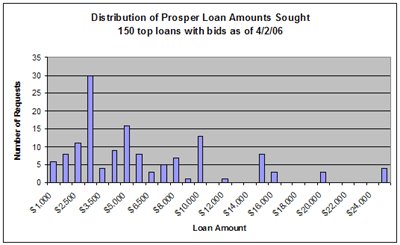
 How liquid is the Prosper lending marketplace? About 2% of the currently listed 750 loans are fully funded and about 40% of the loans have more than one bid. This might sound low, but while the ratio of fully funded loans is generally unchanging at the moment, the number of loans receiving bids is substantially up, even in the last week. Understated interest rates are the primary culprit causing the vast majority of the nearly 5,000 loan listings to date to come and go with no bids despite multiple listing attempts. Diverse amounts for all credit tiers are receiving funding if the interest rate is right, although the fully funded loan of $5,000 is being received by AA-C credit tiers. Below is an indication of the current loans that are receiving bids by size, $3,000 is the average loan size requested.
 Approximately 60% of Prosper's borrowers are in the HR (high risk) or NC (no credit) tier, for which the market interest rate Proper suggests is 24-31%. However, half of the 46 states in which Prosper is licensed have maximum allowed interest rates of 16% or less (including the large markets of NY, NJ, IL, PA and VA) suggesting that over 80% of borrowers (credit tiers D, E, HR and NC) in half of the company's markets cannot borrow. Even the highest rated borrowers, AA with zero existing debt, are suggested to request their loans at 7-9% which seems a bit steep.
There are a few easy steps that could probably significantly improve the ratio of loans funded. First, better loan listings would help. Borrower listings are failing to interest the site's significant amount of deposited lender funds primarily because the requested rates are too low. The required rates may decrease over time as the reputation and repayments of borrowers are posted on the site but at the outset lenders are requiring a higher risk premium. Examples of successful listings, community mentoring and standard features like spellchecker and preview would hopefully increase borrower marketability.
Making the lending process more like an actual market, specifically allowing full flexibility on the interest rate, would also improve liquidity. Lenders should be able to specify their rate for bidding on the listing, above or below the borrower's requested rate. Borrowers should be able to revise their listing to a higher interest rate in process or choose to accept a higher rate at which their loan could be fully funded. The site should eliminate trial and error and allow the market to decide the rate. The rates borrowers want to pay are too low for the current Prosper marketplace.
Over time metrics may emerge that better reflect a borrower's repayment capability than credit ratings and DTI scores, reputation and repayment history as well as other ways an erstwhile borrower could signal to prospective lenders. Lenders could use these alternative metrics to have more comfort and trust in loan listings and bidding liquidity would improve.
Saturday, April 01, 2006
Life – not as we know it
 Life in other places in the universe may be farther or differently evolved such that we do not recognize it. Studying extremophiles on Earth suggests that this could be the most likely form of life uncovered on other planets and moons such as Jupiter's Europa and Callisto and Saturn's Enceladus.
Extremophiles are organisms which thrive in extremely hot or cold temperatures such as deep sea vents and cracks 50-100 km below the Earth’s crust in the mantle. Extremophiles consume and metabolize gas expelled from deep within the Earth, suggesting that the sun or proximity to a sun is not an exclusive pre-condition for life. The total weight of extremophiles is thought to equal that of all of the species of animals living on the surface of the Earth.
Whether archaea extremophiles can evolve into specialized multi-cellular organisms and evolve intelligence is a separate question and perhaps thought to be unlikely. Although some scientists like Thomas Gold in "The Deep Hot Biosphere: The Myth of Fossil Fuels" speculate that the origins of life may be via extremophiles rather than from ponds or amino acid-laden meteorites.


 Email me
 Twitter
 Subscribe to blog
 MS Futures Group
 Data Visualization Wiki
 Economic Fallacies